What are you looking for?

Publications

Here you can find publications on the subject of climate change adaptation in different languages. Please use the filter option to select your preferred language.
  • Topics

  • Types

  • Languages

This good practice summary report offers guidance on identifying and analysing national-level water-related hazards, building on experiences from Georgia, Kazakhstan and Mongolia.
This report presents the most pressing water-related climate hazards in Mongolia together with their probability of occurrence and severity until 2100 as well as possible adaptation measures.
This report presents the most pressing water-related climate hazards in Kazakhstan together with their probability of occurrence and severity until 2100 as well as possible adaptation measures.
This report presents the most pressing water-related climate hazards in Georgia together with their probability of occurrence and severity until 2100 as well as possible adaptation measures.
This report presents the economy-wide impacts of climate change and adaptation in Monbolia conducted for the main climate hazards and for four adaptation measures targeting at agriculture and water management to limit the negative climate change impacts on the economy and people.
Under the CAFRI II project, GIZ India collaborated with the Centre of Excellence on Disaster Mitigation and Management (CoEDMM) at Indian Institute of Technology Roorkee, to develop the Climate-Risk Informed Adaptation Action Assessment (CRIAAA) framework for evaluating the evidence-based approach of sub-national climate plans.
En 2024, EbA LAC elaboró los primeros textos de la serie: Historias reales y cuentos inspirados en mujeres que luchan contra el cambio climático y la pérdida de biodiversidad en América Latina, para ser usados en procesos de capacitación, difusión de información y empoderamiento en temas claves como: cambio climático, pérdida de biodiversidad, cuidado del agua y del medio ambiente, desigualdades en los impactos sobre mujeres y hombres, equidad de género, ganadería y producción sostenible, gestión y acción colectiva comunitaria en estos contextos. Con la difusión de estos materiales, EbA LAC quiere dar la oportunidad a otras mujeres, a jóvenes – y hombres – de aprender de las experiencias de las protagonistas que muestran que existe la posibilidad de lograr cambios y ofrecen herramientas concretas para construir un futuro más sostenible y resiliente al cambio climático con iniciativas comunitarias. El factor de éxito que comparten las historias es la existencia de mujeres fuertes, capacitadas y empoderadas para liderar estos cambios.
Small-scale enterprises in the aquaculture sector of Southeast Africa face considerable challenges due to climate change, severely affecting water availability, disease prevalence, and farm productivity. Extreme weather events like floods or dry spells can already lead to severe crop losses across entire regions if not addressed adequately by fish farmers. Climate-driven changes in temperature and precipitation are expected to have long-term impacts on the aquaculture sector at multiple levels.
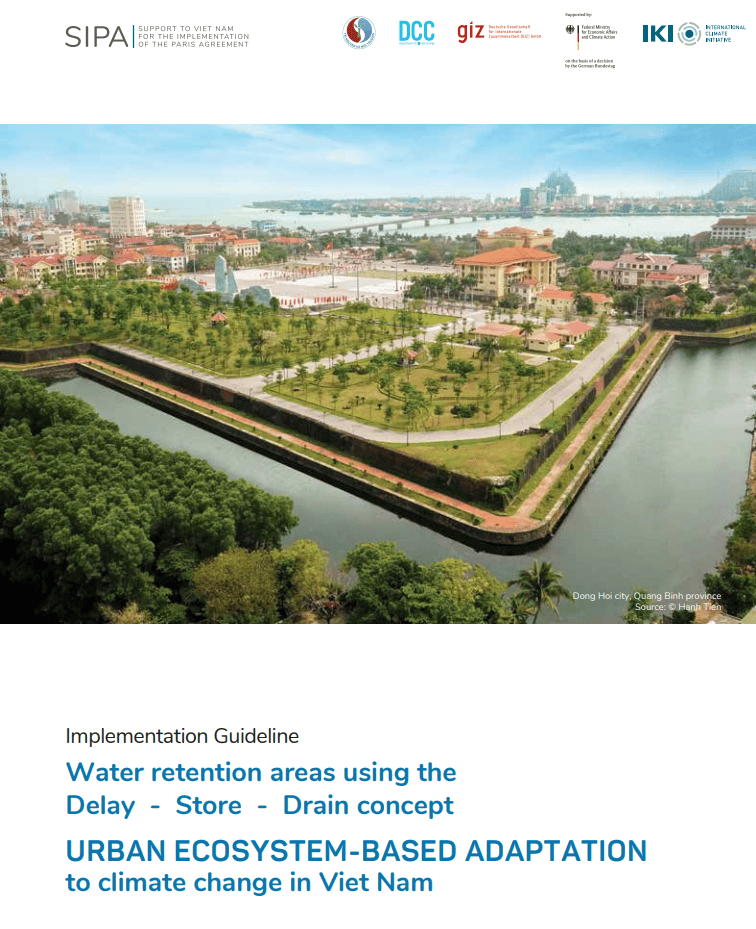
The interrelationship of urban development and growth and the increasing impact of climate change require that adjustments be made to urban planning and development. The integration of elements of Ecosystem-based Adaptation (EbA) into urban development provides an opportunity for cities create attractive, green, healthy, and livable urban spaces. The Implementation Guidelines on Water Retention Areas have been developed based on practical experiences of piloting Water Retention Areas in Dong Hoi city, Quang Binh province, Viet Nam in the scope of the “Support to Viet Nam for the Implementation of the Paris Agreement” (VN-SIPA) project. The guidelines provide an in-depth analysis of the technical concepts regarding the measures and the financial requirements for users.
This manual provides orientation for systematic climate proofing of infrastructure investments. Countries in the Nile Basin invest billions of dollars in durable water infrastructure such as dams, irrigation canals, wells, and others to provide services to people.