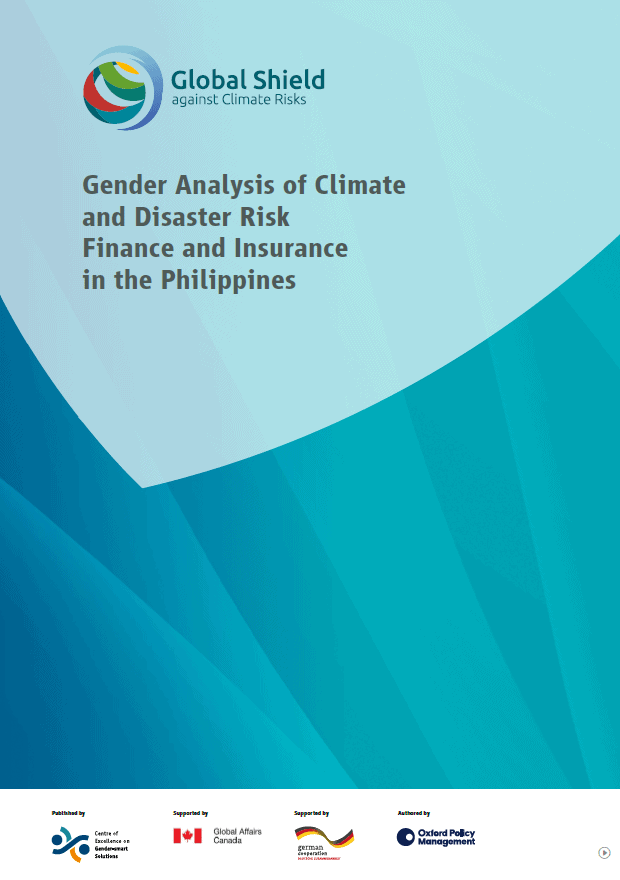
Despite ranking 20th worldwide and 1st in Asia for gender parity in 2025, women in the Philippines continue to face compounded vulnerabilities, resulting in differentiated disaster risks and a need for tailored post-disaster support. Structural factors, including women’s unpaid care burden, concentration in precarious livelihoods, and restrictive social norms (such as limitations on asset ownership and decision-making), constrain financial inclusion by limiting access to formal credit, insurance, and payment channels used for cash-based disaster support. In turn, these constraints affect women’s ability to access and benefit from Climate and Disaster Risk Finance and Insurance (CDRFI) mechanisms, underscoring the importance of tailored and accessible CDRFI as gender-blind programmes risk exacerbating inequalities. This analysis examines how gender is mainstreamed across key CDRFI-related policies and programmes in the Philippines.
An intersectional perspective is applied, with consideration given to other factors of social exclusion that intersect with gender, such as socio-economic status, geographic location, and employment status and sector. The analysis reviews national strategies, policies, and programmes to identify gaps and opportunities for enhancing gender-sensitive CDRFI.
This publication is a product of the Centre of Excellence on Gender-smart Solutions (CoE). The CoE is an initiative that serves as a knowledge hub for advancing gender-responsive approaches within Climate and Disaster Risk Finance and Insurance (CDRFI), providing the latest insights, practical guidance, and opportunities to promote equitable and inclusive solutions.