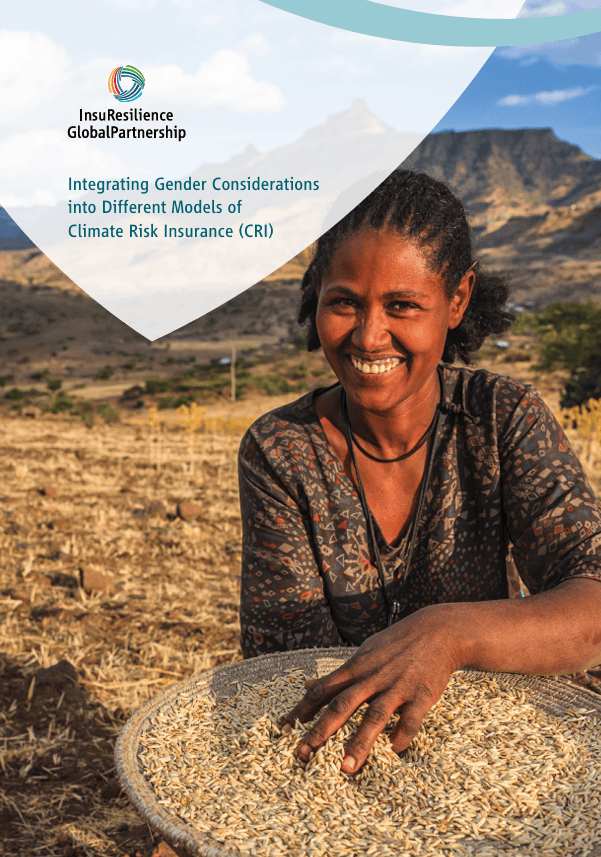
Gender-responsive Climate Risk Insurance (CRI) schemes can provide risk protection that addresses differences in women and men’s vulnerability to both climate risks, and disaster-induced wellbeing loss. This study explores the case for integrating gender and a focus on women into different CRI schemes and provider types at the macro-, meso- and micro-levels. The case for integrating gender considerations into CRI starts with the assumption that women and men can be differentially impacted by, and engaged in, diverse CRI models. Integrating gender considerations into CRI is not about an exclusive focus on women at the exclusion of men, however, taking a focus on gender can lead to a specific emphasis on women due to their greater levels of exclusion from the formal economy and financial system.
This study identifies practical entry points for integrating gender across macro, meso, and micro insurance models—ranging from gender-sensitive product design and data collection to inclusive governance and targeted outreach. Despite progress, implementation remains uneven, with limited use of sex-disaggregated data and insufficient evidence on best practices. The study calls for stronger awareness, better data, and more systematic integration of gender into CRI design and evaluation. It concludes with actionable recommendations, including toolkits, policy guidance, targeted funding, and the development of knowledge platforms and advisory support to scale gender-responsive approaches over time.