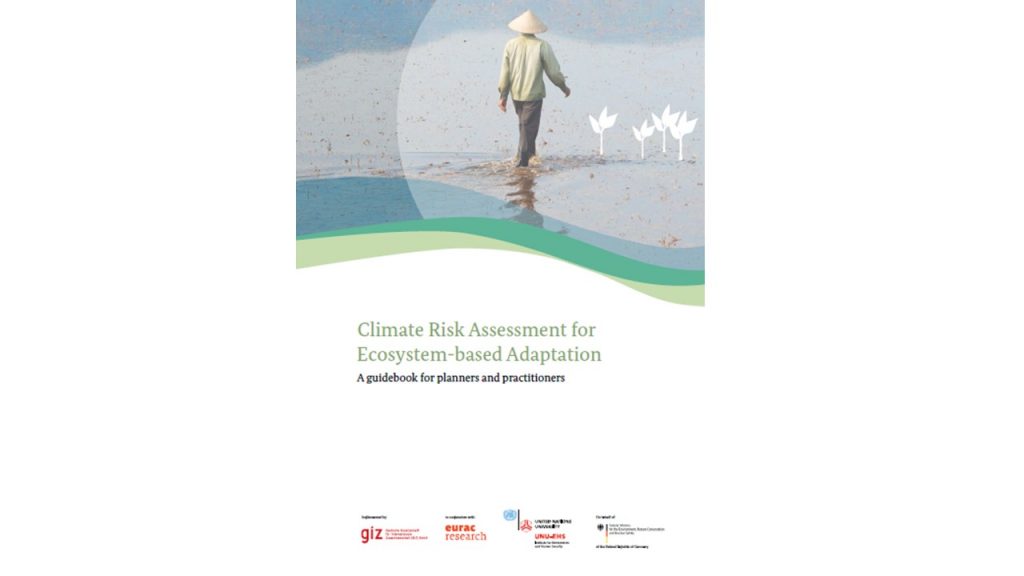
A guidebook developed by GIZ in collaboration with Eurac Research and United Nations University – Institute for Environment and Human Security (UNU-EHS) helps planners and practitioners in designing and implementing climate risk assessments in the context of Ecosystem-based Adaptation projects. It provides a standardized approach to assess risks within social-ecological systems based on two application examples (river basin and coastal zone management) by following the methodology of the GIZ vulnerability sourcebook (GIZ 2014) and its Risk Supplement (GIZ and EURAC 2017). It helps to improve adaptation planning by considering both ecosystem-based and conventional options in the form of integrated ‘adaptation packages’.
It includes the following modules:
1) Preparing the risk assessment
2) Developing impact chains
3) Identifying and selecting indicators for risk components
4-7) From data acquisition to risk assessment
8) Presenting and interpreting the outcomes of the risk assessment
9) Identifying adaptation options
The guidebook can be applied at different stages of adaptation planning, from initial baseline assessments to repeated assessments in the implementation or M&E phase.
View the report here