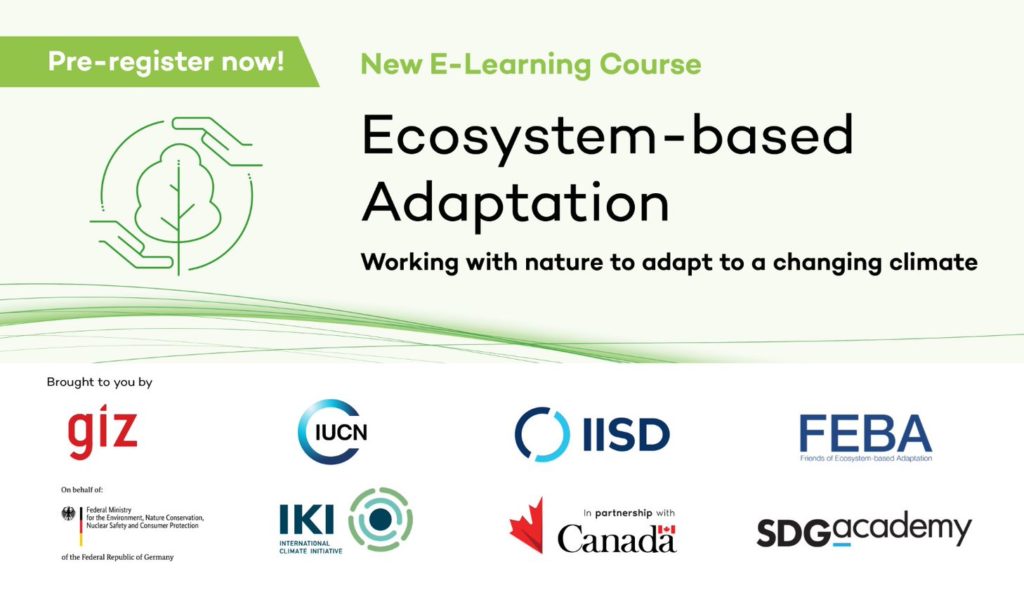
You can now enroll for a new self-paced E-learning course on Ecosystem-based Adaptation.
The course, which was developed by GIZ, IUCN and IISD, will be launched September, but pre-registration is already possible now. For pre-registration, please sign-up here.
Once signed up, you will be informed about the launch of the course and can explore the different units and modules as soon as they are available.
The course is published on the online learning platform edX.org and is free of charge. It consists of nine units comprised of video lectures, case studies, quizzes, and handouts. It equips learners with transferable and replicable skills in designing and implementing EbA initiatives by offering targeted training on key principles, risk assessments, monitoring, and governance. A core focus of the course lies on cross-cutting topics such as gender, governance, local and Indigenous knowledge or just EbA. These themes are addressed both in own modules as well as throughout other course units.
The course targets decision-makers in public and private organizations; professionals who may not be familiar with EbA but who work in a related field, civil society organizations, actors at community, national, and global scales, early-career EbA professionals, current students, university faculty, and EbA practitioners from both the Global North and Global South.