Mapping Potential Funding Sources for Ecosystem-based Adaptation Insurance Premiums
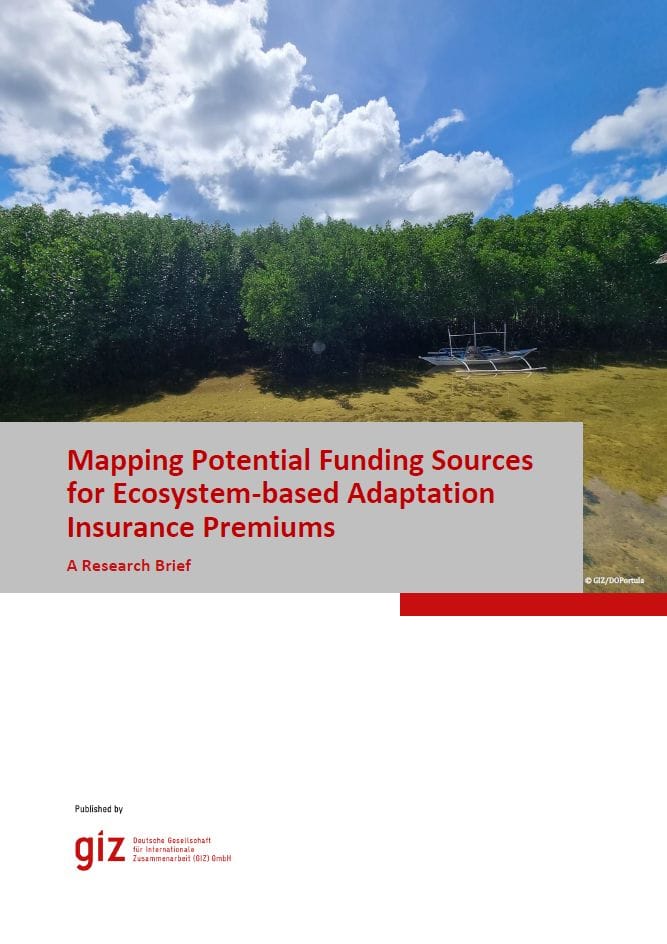
This study presents an exploratory, legitimate, and fiscal analysis of potential public financing pathways that can enable Local Government Units (LGUs) to pay premiums for parametric insurance schemes aimed at protecting and restoring mangrove and marine ecosystems.
Análisis de genero e inclusión social en la protección financiera y mecanismos de aseguramiento frente al riesgo climático y de desastres en el Perú
Este informe evalúa la integración del enfoque de género en las iniciativas de la protección financiera y mecanismos de aseguramiento frente al riesgo climático y de desastres (CDRFI, por sus siglas en inglés) en el erú. Se basa en una investigación documental de políticas, programas y mecanismos de financiamiento relevantes dirigidos a mujeres y grupos vulnerables. El análisis se centra en identificar brechas de género dentro de stos marcos relacionados con la CDRFI, con especial atención a las mujeres.
Gender in Climate and Disaster Risk Finance and Insurance in Malawi
This analysis examines the integration of gender within CDRFI policies, programmes and instruments to increase financial protection for vulnerable people in Malawi. It identifies systemic barriers and provides actionable recommendations to ensure equitable access to financial resources that build resilience and mitigate the economic impacts of climate-related disasters.
Gender in Climate and Disaster Risk Finance and Insurance in Somalia
This report reviews how GESI is (or can be) integrated into existing CDRFI-relevant policies and programmes in Somalia, identifying gaps, barriers and potential access points for the inclusion of women and marginalised groups. It offers some recommendations for improving inclusion in an emergent CDRFI landscape within a fragile and conflict-affected state.
Gender Analysis of Climate and Disaster Risk Finance and Insurance in the Philippines
This analysis examines how gender is mainstreamed across key CDRFI-related policies and programmes in the Philippines. An intersectional perspective is applied, with consideration given to other factors of social exclusion that intersect with gender, such as socio-economic status, geographic location, and employment status and sector. The analysis reviews national strategies, policies, and programmes to identify gaps and opportunities for enhancing gender-sensitive CDRFI.
Gender Analysis of Climate and Disaster Risk Finance and Insurance in Madagascar
Madagascar is highly exposed to climate-related shocks, including recurrent cyclones and droughts, which disproportionately affect women due to entrenched social norms, high poverty levels, and limited access to land ownership and financial services. This report, commissioned by the Centre of Excellence on Gender-smart Solutions and conducted by Oxford Policy Management, examines how Climate and Disaster Risk Finance and Insurance (CDRFI) policies and programmes in Madagascar integrate Gender Equality and Social Inclusion (GESI), and assesses whether existing frameworks effectively address differentiated vulnerabilities.
Gender Analysis of Climate and Disaster Risk Finance and Insurance in Senegal
Climate change poses significant risks and impacts that disproportionately affect vulnerable groups, particularly women. While measures such as access to credit, savings tools, and affordable insurance products can help mitigate losses and damages caused by climate-related events, there are stark gender-specific differences in how these risks and impacts are experienced.
This review primarily focuses on the integration of gender considerations in CDRFI policies and programmes in Senegal, with only partial exploration of other aspects of social inclusion. The aim is to identify gaps and provide recommendations for integrating and/or strengthening gender-responsive approaches within CDRFI.
Enhancing Risk Assessments (ERA) for Improved Country Risk Financing Strategies – Factsheet
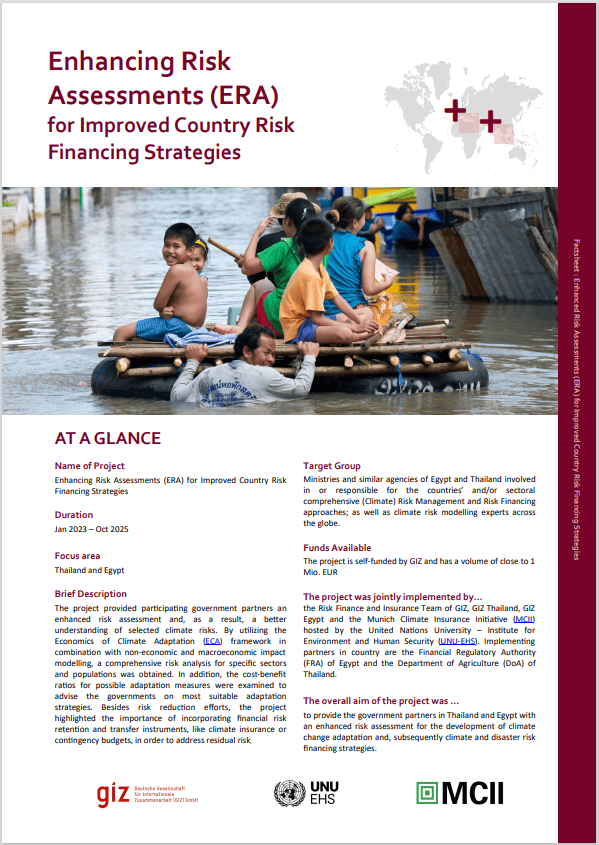
The overall aim of the ERA project was to provide the government partners in Thailand and Egypt with an enhanced risk assessment for the development of their adaptation and risk financing strategies. The project was implemented by GIZ together with the Munich Climate Insurance Initiative (MCII) hosted by the United Nations University.
Enhancing Risk Assessments (ERA) for Improved Country Risk Financing Strategies – Final Report Thailand

The overall aim of the ERA project was to provide the government partners in Thailand with an enhanced risk assessment for the development of their adaptation and risk financing strategies.This final report delivers a comprehensive assessment of climate risks in Egypt to support adaptation planning and risk financing strategies.
Enhancing Risk Assessments (ERA) for Improved Country Risk Financing Strategies – Final Report Egypt

The overall aim of the ERA project was to provide the government partners in Egypt with an enhanced risk assessment for the development of their adaptation and risk financing strategies.
This final report delivers a comprehensive assessment of climate risks in Egypt to support adaptation planning and risk financing strategies.