Opportunities for Strengthening Resilience by Integrating Climate and Disaster Risk Finance and Insurance (CDRFI) in National Adaptation Plan (NAP) Processes
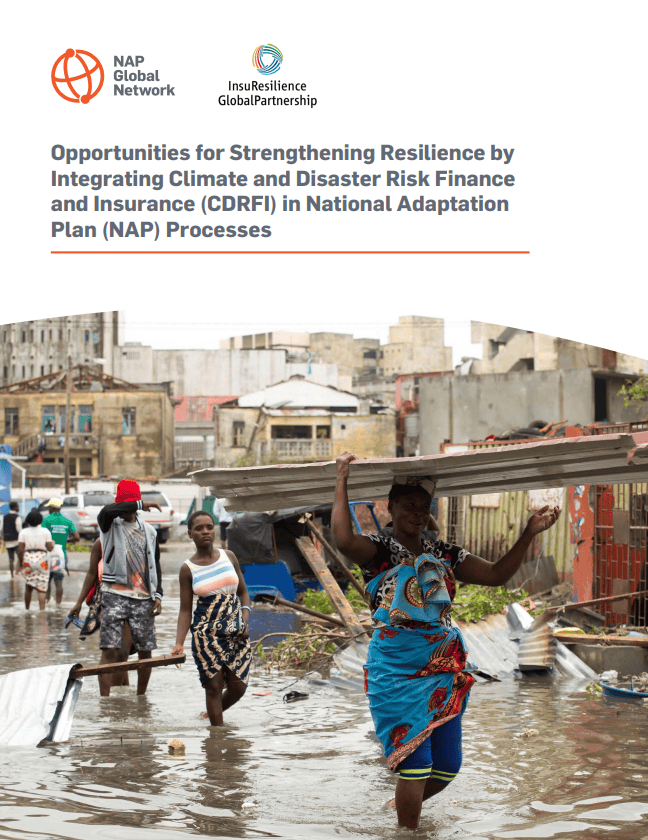
The result of a collaboration between InsuResilience and the NAP GN, a new report examines entry points for CDRFI to enhance national resilience-building efforts through NAPs. It presents an analysis of ways in which existing National Adaptation Plans and those under way have already integrated CDRFI, and suggests ways for both NAP and CDRFI actors to increasingly consider interlinkages in the future.
Oportunidades para reforzar la resiliencia mediante la integración de financiación y seguros contra riesgos climáticos y desastres naturales (CDRFI por sus siglas en inglés) en los procesos del Plan Nacional de Adaptación (PNAD)
El análisis que se presenta en este informe permite comprender mejor las formas en que los países están integrando las soluciones CDRFI en sus esfuerzos por formular y aplicar los Planes Nacionales de Adaptación (PNAD), así como las oportunidades perdidas. El análisis es resultado de la colaboración entre la Red Global de PNAD y la Asociación Global InsuResilience (IGP).
Possibilités de renforcer la résilience en intégrant le financement et l’assurance des risques climatiques et de catastrophes (CDRFI) dans les Plans nationaux d’adaptation (PNA)
L’analyse fournie dans le présent rapport permet de mieux comprendre comment les pays intègrent le CDRFI dans leurs efforts visant à formuler et à mettre en œuvre leur planification de l’adaptation PNA et de déceler les occasions manquées. Cette analyse est le fruit d’une collaboration entre le Réseau mondial de PNA et le Partenariat mondial InsuResilience (IGP).
Integrating Risk Finance into National Resilience and Adaptation Efforts
Adaptation is vital to make society resilient to the impacts of climate change. This Policy Note examines how risk financing considerations can enhance vulnerable economies’ resilience efforts if integrated into national adaptation and investment processes, and efforts to address loss and damage.
Glossary of key terms and concepts for gender, as it relates to Climate and Disaster Risk Finance and Insurance
This document aims to provide clear definitions for commonly used terms and key concepts related to the intersection of gender and climate and disaster risk finance and insurance (CDRFI). It was jointly developed by members of the InsuResilience Gender Working Group.
Integrating Gender Responsive Strategies into Climate and Disaster Risk Finance and Insurance Solutions
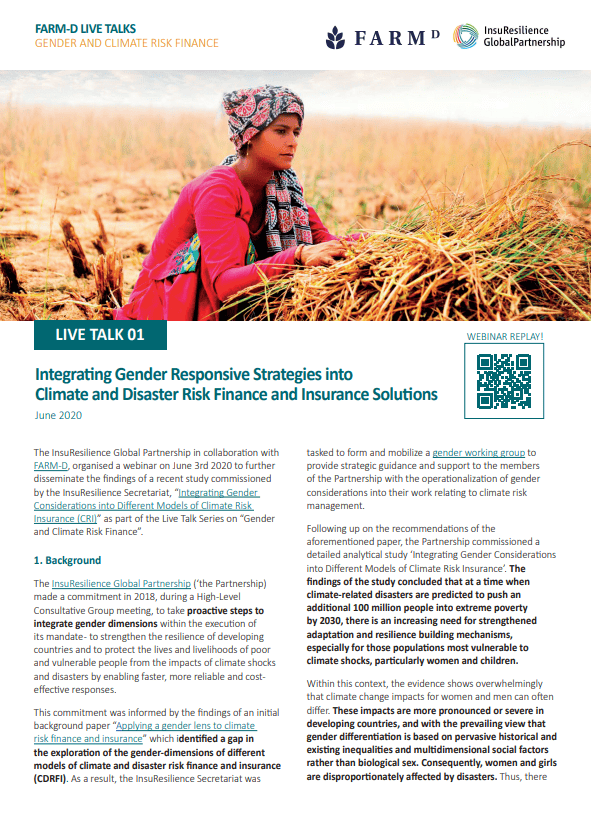
The InsuResilience Global Partnership in collaboration with FARM-D, organised a webinar on June 3rd 2020 to further disseminate the findings of a recent study commissioned by the InsuResilience Secretariat, “Integrating Gender Considerations into Different Models of Climate Risk Insurance (CRI)”. This event report summarizes key takeaways from the live talk.
Analysing Stakeholder Needs for Enhancing Climate and Disaster Risk Data
This study provides an overview of data, modelling and analytics in the context of disaster risk finance through the lens of a stakeholder analysis in order to identify supply- or demand-side gaps. It supports the InsuResilience Global Partnership (‘the Partnership’) as a point of departure to address these gaps, and to improve data production, access and application for better climate and disaster risk management and to assist with developing risk financing solution.
Integrating Gender Considerations into Different Models of Climate Risk Insurance (CRI)
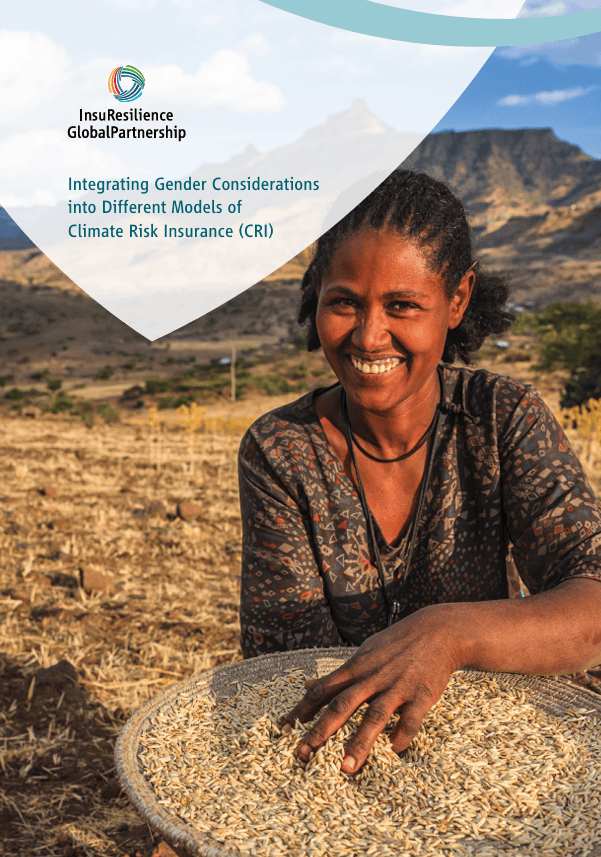
Gender-responsive Climate Risk Insurance (CRI) schemes can provide risk protection that addresses differences in women and men’s vulnerability to both climate risks, and disaster-induced wellbeing loss. This study explores the case for integrating gender and a focus on women into different CRI schemes and provider types at the macro-, meso- and micro-levels.
Ecosystem-based Adaptation and Insurance: Success, Challenges and Opportunities
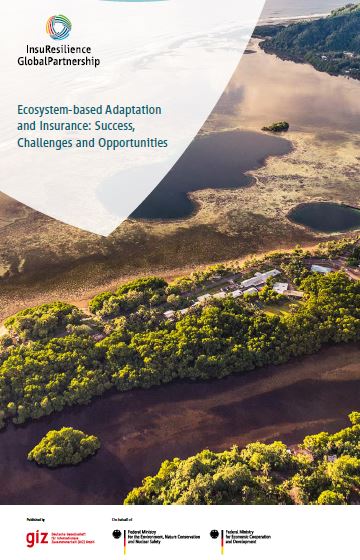
Both Ecosystem-based Adaptation (EbA) and Climate Risk Finance & Insurance (CRFI) can be used to enhance adaptation, reduce and transfer risk, and build resilience to the growing impacts from natural and human-made hazards. There is a nascent and growing interest in where these strategies may intersect and be mutually beneficial for adaptation. The GIZ joint publication by the Global Project Mainstreaming EbA, the InsuResilience Secretariat and ACRI+ is available now.
The Future of Disaster Risk Pooling for Developing Countries: Where Do We Go from Here?
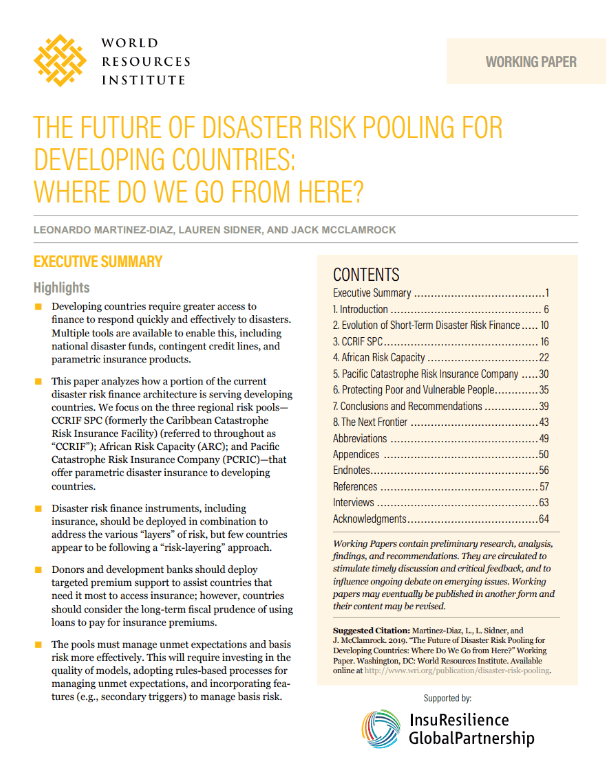
Developing countries require greater access to finance to respond quickly and effectively to disasters. Multiple tools are available to enable this, including national disaster funds, contingent credit lines, and parametric insurance products. This paper analyzes how a portion of the current disaster risk finance architecture is serving developing countries.