Supplementary Factsheet – Climate risk analysis for identifying and weighing adaptation strategies in Ghana’s agricultural sector
This factsheet is supplement to the “Climate risk analysis for identifying and weighing adaptation strategies in Ghana’s agricultural sector” which was prepared by the Potsdam Institute for Climate Impact Research (PIK) for the Deutsche Gesellschaft für Internationale Zusammenarbeit (GIZ) GmbH on behalf of the German Federal Ministry for Economic Cooperation and Development (BMZ).
Executive Summary – Climate risk analysis for identifying and weighing adaptation strategies in Ghana’s agricultural sector
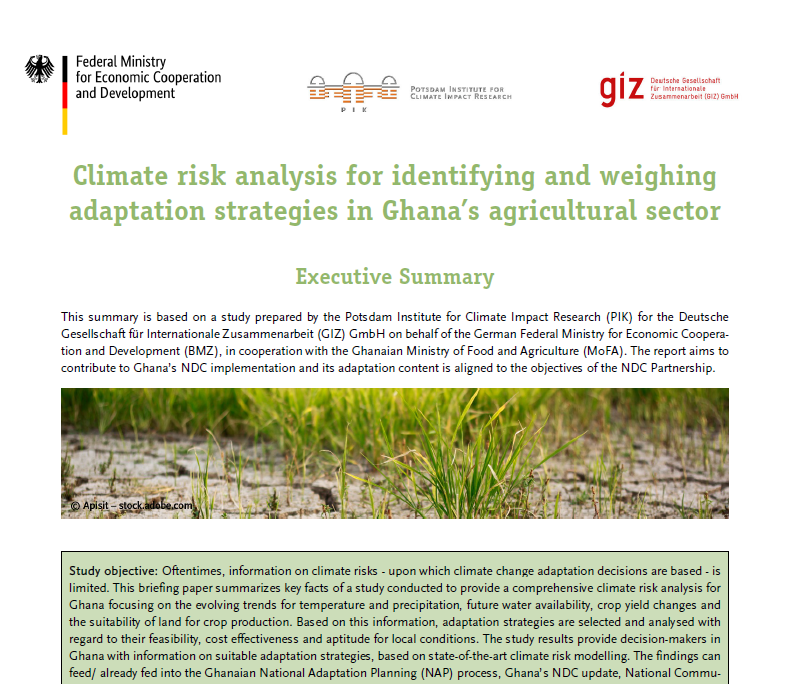
The executive summary has been developed based on information and findings of the “Climate risk analysis for identifying and weighing adaptation strategies in Ghana’s agricultural sector” which was prepared by the Potsdam Institute for Climate Impact Research (PIK) for the Deutsche Gesellschaft für Internationale Zusammenarbeit (GIZ) GmbH on behalf of the German Federal Ministry for Economic Cooperation and Development (BMZ).
Climate Risk Profile: Ghana
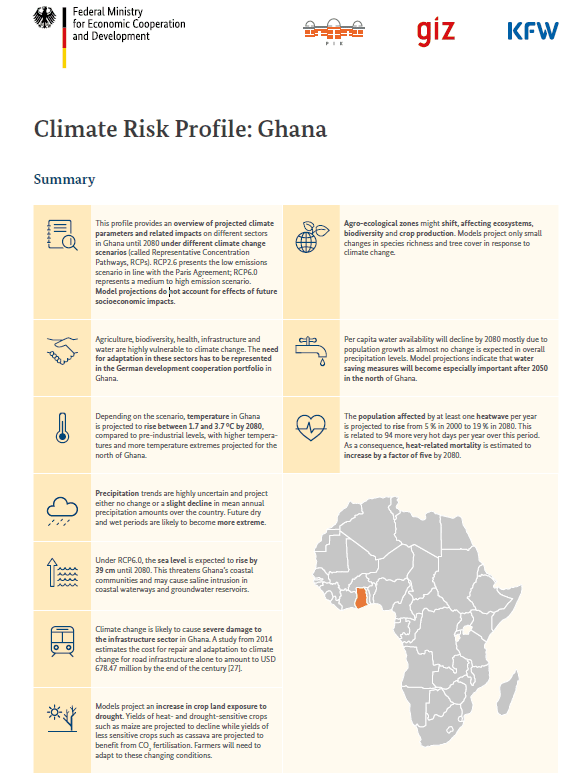
It provides a snapshot of projected climate parameters and related impacts on key sectors in Ghana until 2080 under different climate change scenarios. Thereby, it builds on state-of-the-art modelling of the latest climate data and makes main findings accessible to non-experts and decision-makers through easy-to-read graphs and texts.
Climate Risk Analysis for Identifying and Weighing Adaptation Strategies in Ghana’s Agricultural Sector
The study focuses on evolving trends for temperature and precipitation, future water availability and the country’s suitability to grow crops. The study’s projections go up to 2090, offering opportunities not only to look into short-term trends (2030), but also to take into account -with great precision- medium (2050) and long-term climate change impacts. In addition, the study undertakes a cost-benefit analysis of selected adaptation options on which basis “business cases” for adaptation can be identified.
Climate change and small-scale fisheries
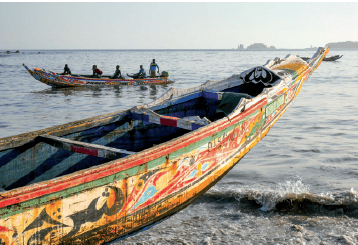
The fisheries sector contributes significantly to income and food security for hundreds of millions of people, particularly in Small Island Developing States (SIDS) and coastal Least Developed Countries (LDCs).
Étude de la vulnérabilité des systèmes de production agro-sylvo-pastoraux face aux changements climatiques dans les provinces du Houet et du Tuy au Burkina Faso
La présente étude, réalisée dans le cadre de la composante 2 du Projet d’Appui Scientifique aux processus de Plans Nationaux d’Adaptation (PAS-PNA), combine des sorties de modèles climatiques, une revue de la littérature et des entretiens avec des personnes ressources pour élucider la manifestation des changements climatiques, leurs impacts, les options d’adaptation et leur efficacité dans les provinces du Houet et du Tuy au Burkina Faso.
Comprendre et interpréter les sorties de modèles climatiques pour la conduite des études de vulnérabilité
Guide à l’attention des praticiens et des chercheurs pour se familiariser avec une gamme variée de sorties de modèles climatiques et pour analyser les résultats des modèles suivant leur contexte.
Ecosystem-based Adaptation and Insurance: Success, Challenges and Opportunities
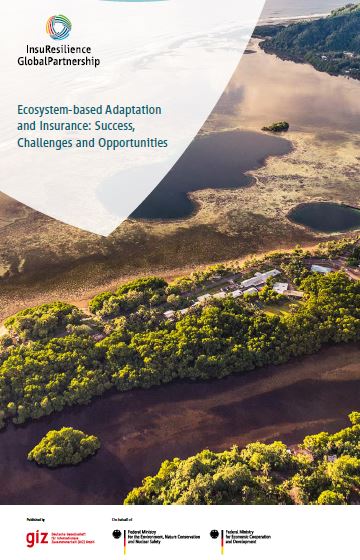
Both Ecosystem-based Adaptation (EbA) and Climate Risk Finance & Insurance (CRFI) can be used to enhance adaptation, reduce and transfer risk, and build resilience to the growing impacts from natural and human-made hazards. There is a nascent and growing interest in where these strategies may intersect and be mutually beneficial for adaptation. The GIZ joint publication by the Global Project Mainstreaming EbA, the InsuResilience Secretariat and ACRI+ is available now.
Ecosystem-based Adaptation and Insurance
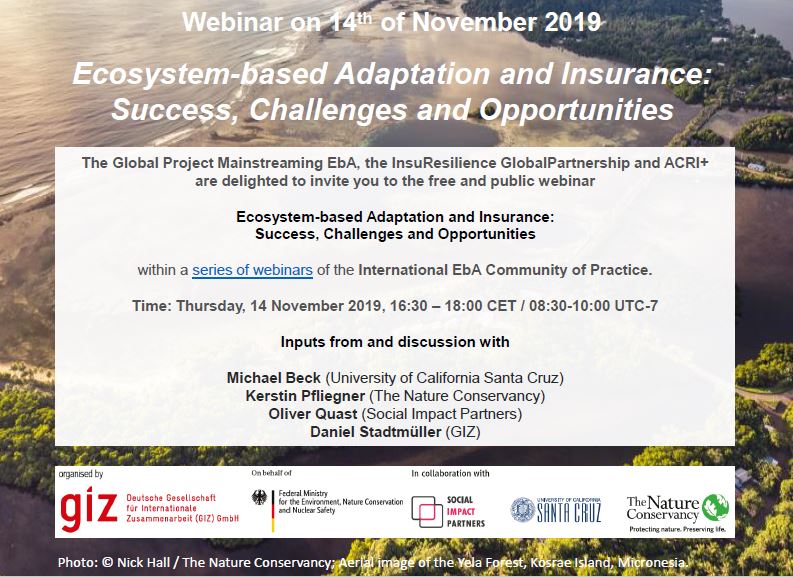
The Global Project Mainstreaming EbA, the InsuResilience GlobalPartnership and ACRI+ are delighted to present you the public online session ‘Ecosystem-based Adaptation and Insurance: Success, Challenges and Opportunities’.
Étude de l’impact des changements climatiques futurs sur les ressources en eau au Burkina Faso
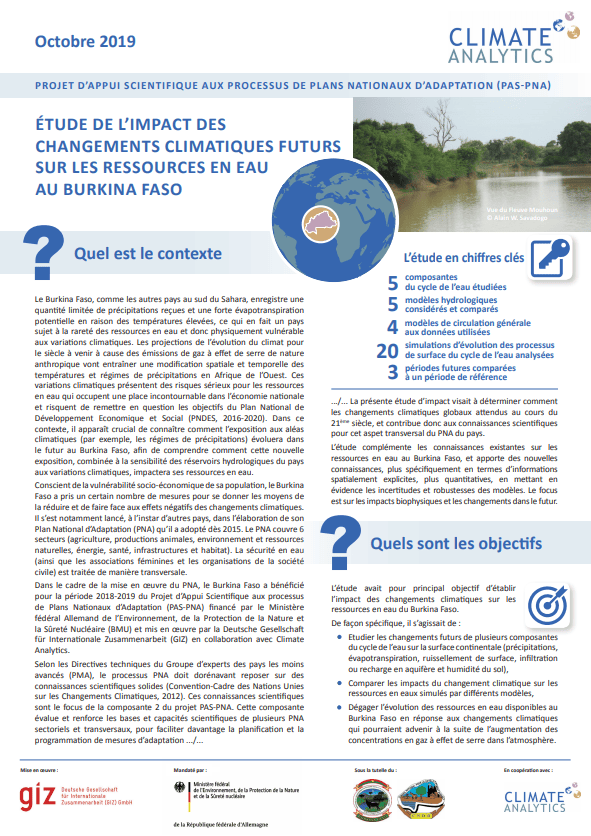
Cette fiche présente brièvement l’étude de l’impact des changements climatiques futurs sur les ressources en eau au Burkina Faso dans le cadre de la composante 2 du Projet d’Appui Scientifique aux processus de Plans Nationaux d’Adaptation (PAS-PNA).