Disasters are becoming more frequent, more intense, and increasingly interconnected. Floods, droughts, storms, heatwaves, and other hazards can reverse years of development progress, disrupt essential services, and deepen existing inequalities. At the same time, many risks are created or amplified by development decisions themselves.
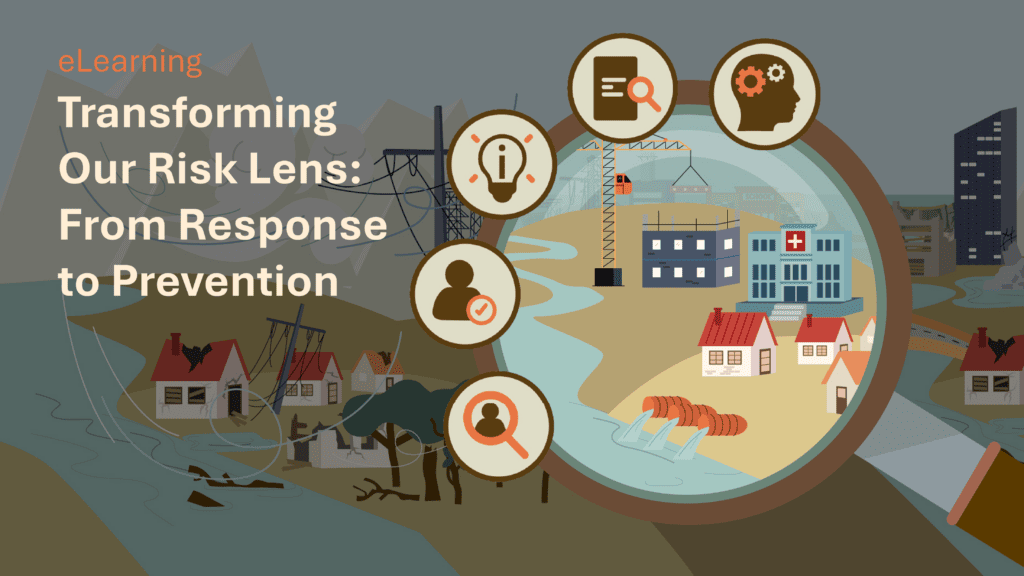
To help development practitioners better understand and address these challenges, the Global Initiative on Disaster Risk Management (GIDRM) has launched a new course on atingi: Transforming our Disaster Risk Lens: From response to prevention.
What is this course about?
The course introduces the foundations of disaster risk management (DRM) and explores how risk considerations can be systematically integrated into development planning and decision-making.
Rather than focusing solely on responding to disasters once they occur, the course encourages learners to…
- understand risk,
- prevent new risks from being created,
- strengthen resilience across sectors.
It is designed for development practitioners, policymakers, programme managers, and anyone interested in promoting risk-informed development.
Why does this course matter?
Disaster risk management is not the responsibility of a single sector or institution. Building resilience requires collaboration across governments, communities, civil society, and the private sector. Whether working on infrastructure, governance, finance, social protection, climate change, or urban development, all development actors have a role to play in preventing and reducing risk.
This course supports this shift in perspective – from reacting to disasters to understanding and managing risk before disasters happen.
What can learners expect?
The eLearning combines self-paced study with applied learning components, such as interactive content, scenario-based exercises and practical examples.
Throughout the course, learners explore the fictional country of Naisa, applying DRM concepts to realistic situations and development challenges that mirror those faced in many countries around the world.
The course consists of three modules:
- Foundations of Disaster Risk Management and Risk-Informed Development
- Deep Dive: Good Financial Governance
- Deep Dive: Social Protection
Start learning today!
The eLearning course is available free of charge on atingi and can be completed at your own pace. Through interactive exercises, practical examples, and realistic scenarios, it offers actionable insights that can be applied across a wide range of development contexts.
Ready to transform your risk lens? Start the course today and discover how disaster risk management can contribute to more resilient and sustainable development – and feel free to share it with colleagues and partners who might benefit from it too.
Questions or feedback? Please contact info@gidrm.net.
Download: Transforming our Disaster Risk Lens: From response to prevention