About the guide:
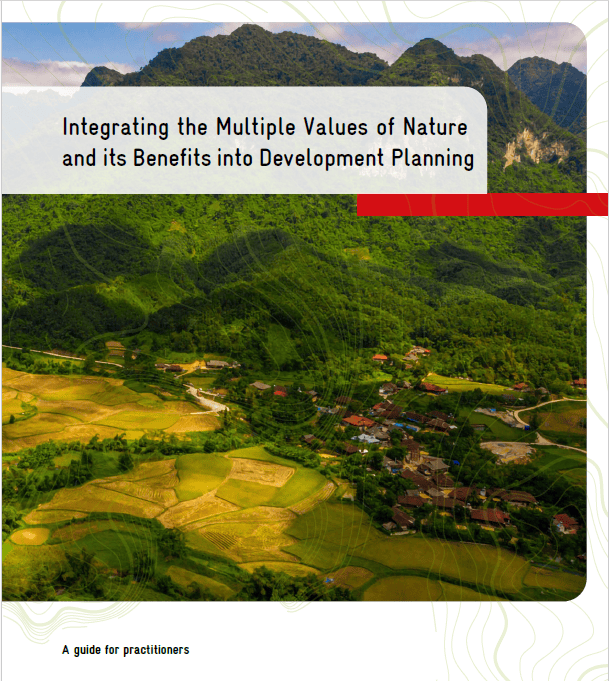
The “Integrating the Multiple Values of Nature and its Benefits into Development Planning” guide for practitioners builds on GIZ’s earlier work on policy-oriented ecosystem service assessment and valuation.
It seeks to assist in operationalising the concepts and principles in the IPBES values assessment, with a view to better mainstreaming the multiple values of nature and its benefits into development planning.
The guide is targeted at development practitioners, including those responsible for designing projects and programmes, planning interventions, formulating policies, and implementing, backstopping and monitoring the delivery of on-the-ground activities.
First of all, the guide explains key concepts and terminology, and describes the rationale to integrating multiple values. It then proposes a process and principles for doing this, goes on to identify concrete tools and approaches that can be used, and provides a list of reference materials that can be used to further inform such efforts.
A framework for integration
The guide advances the valuation approach and leverage points for transformative change identified in the IPBES Value Assessment. It translates these into a practical and policy-relevant framework for integrating multiple values into development planning, involving four key stages:
- framing the development process and priorities, by ensuring these are aligned with diverse conceptualisations and multiple values,
- diagnosing the linkages, by assessing how development processes depend, impact and are shaped by multiple values,
- responding to needs to leverage change, by identifying and designing policy instruments to influence people’s behaviour and decisions, and
- embedding the results, by transforming information into clear and compelling decision-making evidence, advice and support.
Multiple values & diverse conceptualisations
People value nature very differently, depending on where and how they live, their cultural background, institutions, principles, preferences and worldviews. In some cases, people’s perceptions and experiences diverge, contradict, or even come into conflict.
Not only is it necessary to recognise these diverse conceptualisations of nature’s benefits to people, but also to acknowledge that there is no single method with which to understand, measure or express these multiple values.
This requires that we move beyond the narrow economic arguments and utilitarian narratives that have traditionally guided development planning. There is a need to adopt more holistic and pluralistic approaches that explicitly incorporate the perspective of multiple stakeholders, scientific disciplines and knowledge systems, including indigenous and local knowledge.
Why do multiple values matter to development planning?
The IPBES values assessment has great relevance to development planning. There is an urgent need to consider how to operationalise and apply the concepts and frameworks it describes in the context of today’s conservation and development priorities – for example the Sustainable Development Goals, 2050 Vision for Biodiversity and Kunming-Montreal Global Biodiversity Framework, including ongoing work to update countries’ National Biodiversity Strategies and Action Plans, and to promote nature-positive investments and nature-based solutions.
Considering people’s diverse worldviews and multiple values does not only help to improve the design, implementation and outcomes of development policies and plans. It is also vital to the uptake, acceptance and ultimate success of such efforts, and to creating the conditions for the transformative change that is required for a more sustainable and just future. Recognising and respecting different values and knowledge systems also requires development planning to be more inclusive, which translates into better outcomes for people and nature.
In contrast, failing to take a pluralistic approach leads to the danger that particular values and interests will be overlooked, or even harmed in the course of planning and implementing ‘development’. These risks are particularly acute for groups that are already marginalised or vulnerable in social, political and economic terms, such as indigenous peoples and local communities.
⇒ Access the guide here: Integrating the Multiple Values of Nature and its Benefits into Development Planning