
The overall aim of the ERA project was to provide the government partners in Thailand and Egypt with an enhanced risk assessment for the development of their adaptation and risk financing strategies.
The Economics of Climate Adaptation (ECA) framework was applied, supported by probabilistic risk modelling implemented using the open-source risk assessment tool ‘CLIMADA’, which was enhanced to capture non-economic as well as macroeconomic impacts. In addition, the cost-benefit ratios for possible adaptation measures were examined to advise the governments on most suitable adaptation strategies. Besides risk reduction through adaptation, the project highlighted the importance of incorporating financial risk retention and transfer instruments in order to address residual risks. Moreover, trainings were conducted with partners on topics such as integrated climate risk management, data management, and how to utilize the newly created graphical user interface (GUI) for CLIMADA.
The ERA project was implemented by GIZ’s Risk Finance & Insurance Team, GIZ Egypt, and GIZ Thailand together with the Munich Climate Insurance Initiative (MCII) hosted by the United Nations University – Institute for Environment and Human Security (UNU-EHS).
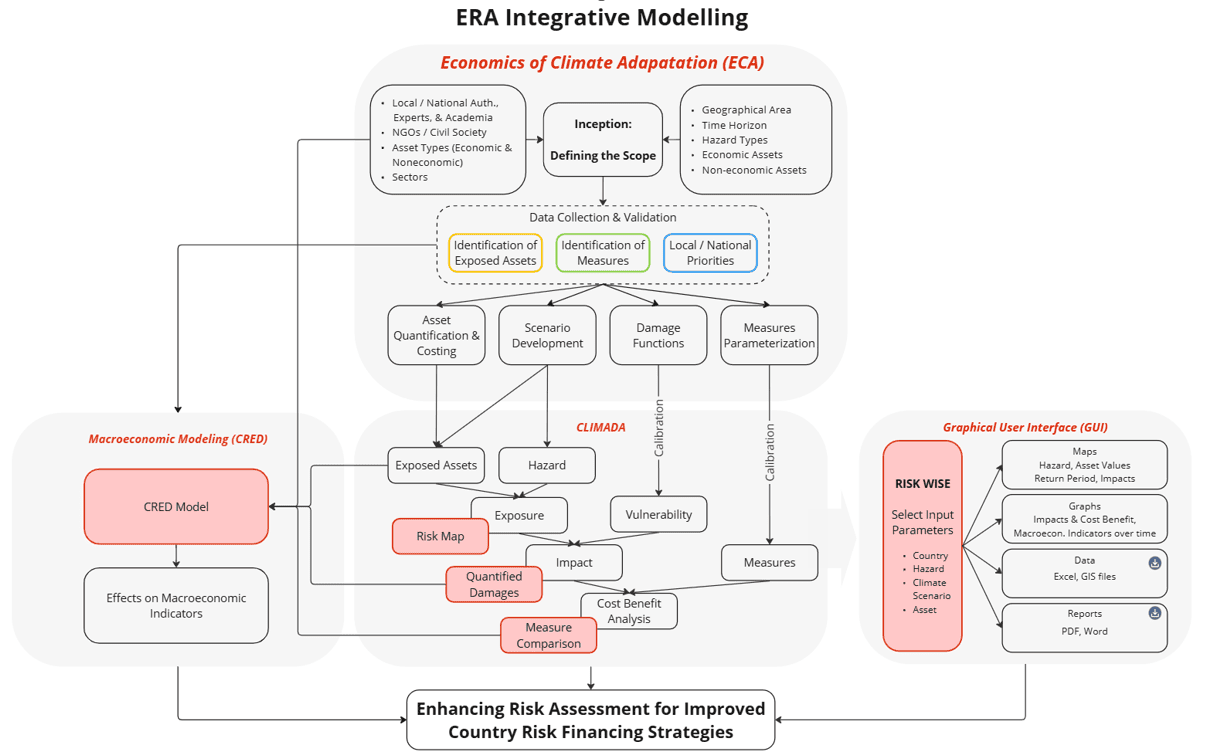
This figure presents the ERA Integrative Modelling Framework, designed to inform comprehensive country adaptation and risk financing strategies through an enhanced climate risk assessment approach. This framework established a national-level analytical system for assessing and managing climate-related risks by integrating economic, non-economic, and macroeconomic models to enhance decision-making for risk financing. It draws on the ECA framework, probabilistic risk modelling implemented using CLIMADA, macroeconomic modelling based on a general dynamic equilibrium model developed by the Climate Resilient Economic Development (CRED) project, and a GUI that visualizes results for a broader audience. Together, these components enable a comprehensive assessment of climate risks, impacts, and adaptation options, supporting more resilient and sustainable development planning.
While represented as distinct components, the four components of the ERA Integrative Modelling Framework draw from and feed into one another. Without the ECA framework, CLIMADA offers top-down results not shaped or validated by local stakeholders. The consultation activities from ECA ensured that model-based results are grounded in country priorities and validated through stakeholder engagement. Coupling CLIMADA with the macroeconomic model of CRED links geolocated, physically based risk estimates with economy-wide macroeconomic dynamics. This mix offers an important improvement from most macroeconomic models, which view the impacts of climate change as a slow-onset process specified by a small set of parameters. Finally, the development of an accessible GUI enables different audiences to engage with complex analytical results in a more intuitive and transparent manner.
You are currently viewing a placeholder content from Vimeo. To access the actual content, click the button below. Please note that doing so will share data with third-party providers.
More InformationYou are currently viewing a placeholder content from YouTube. To access the actual content, click the button below. Please note that doing so will share data with third-party providers.
More InformationYou need to load content from reCAPTCHA to submit the form. Please note that doing so will share data with third-party providers.
More InformationYou need to load content from reCAPTCHA to submit the form. Please note that doing so will share data with third-party providers.
More InformationYou are currently viewing a placeholder content from Google Maps. To access the actual content, click the button below. Please note that doing so will share data with third-party providers.
More InformationYou are currently viewing a placeholder content from Google Maps. To access the actual content, click the button below. Please note that doing so will share data with third-party providers.
More InformationYou are currently viewing a placeholder content from Mapbox. To access the actual content, click the button below. Please note that doing so will share data with third-party providers.
More InformationYou are currently viewing a placeholder content from OpenStreetMap. To access the actual content, click the button below. Please note that doing so will share data with third-party providers.
More InformationYou are currently viewing a placeholder content from reCAPTCHA. To access the actual content, click the button below. Please note that doing so will share data with third-party providers.
More Information