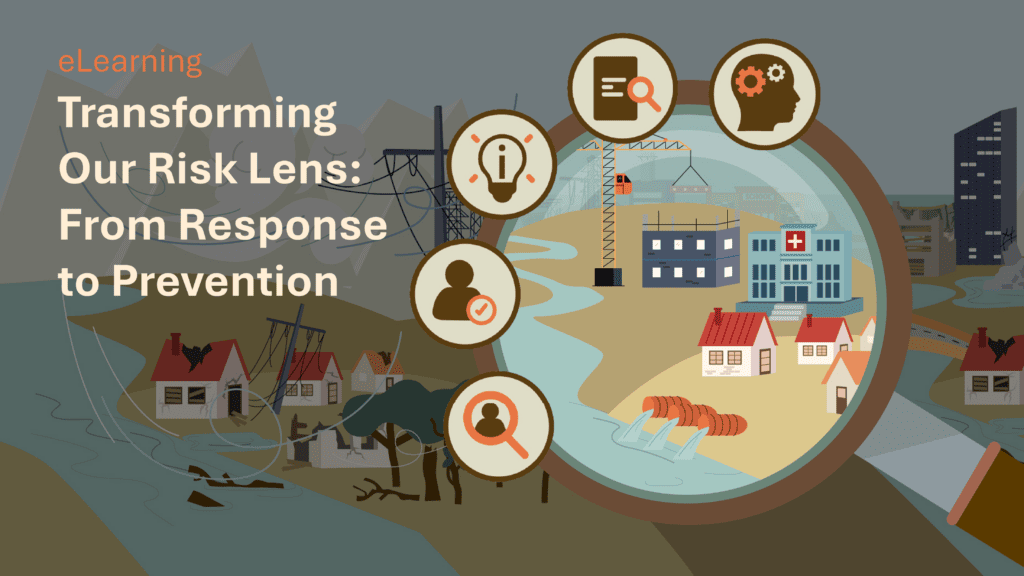

As African cities continue to grow at an unprecedented pace, urban planners, policymakers, and development practitioners are increasingly confronted with the challenges of climate change, disaster risks, and rapid urbanization. Building resilient cities requires not only investment and action but also the knowledge and skills to make informed decisions.
The Resilience Initiative Africa (RIA), a regional project implemented by Deutsche Gesellschaft für Internationale Zusammenarbeit (GIZ) GmbH on behalf of the German Federal Ministry for Economic Cooperation and Development (BMZ), has made available the eLearning course on Risk-Informed Urban Development (RIUD) in African Cities.
Access the course here:
- RIUD Africa (English)
- RIUD Africa (Français)
A Learning Journey Across Africa
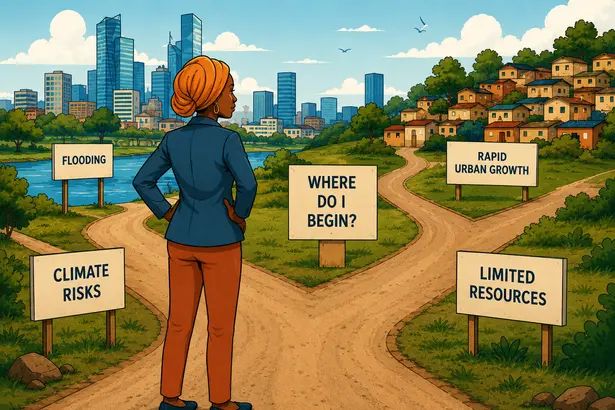
In this interactive, story-driven course, learners accompany Amina, an urban development specialist, on a mission across Africa. From city to city, Amina meets local communities, city officials, and urban practitioners who are working to address risks and strengthen resilience.
In the course, learners explore practical approaches to risk-informed urban development and discover how African cities can better prepare for future challenges.
Each module takes learners to a different urban context, including:
- Module 1 – Introduction to Risk-Informed Urban Development (Maputo)
- Module 2 – Risk Assessments and Data-Informed Decision Making (Kampala)
- Module 3 – Governance and Financing for Urban Resilience (Accra)
- Module 4 – Prevention and Preparedness (Cairo)
- Module 5 – Water Resilience in Cities (Windhoek)
- Module 6 – Resilient Housing and Safer Settlements (Lagos)
What Will You Learn?
By the end of the course, participants will be able to:
- Understand the principles and components of Risk-Informed Urban Development (RIUD)
- Identify and assess climate, environmental, and human-made hazards
- Analyze vulnerabilities and risks affecting urban communities
- Apply governance and financing approaches that strengthen urban resilience
- Explore the design and implementation of effective Early Warning Systems (EWS)
- Integrate climate and disaster risk considerations into urban planning and decision-making processes
- Learn from case studies inspired by experiences from Mozambique, Uganda, Nigeria, Ghana, Namibia and Egypt
Flexible Learning, Practical Impact
The course is available in English and French. It is entirely self-paced and can be completed in approximately 2 hours. Participants who successfully complete all modules and assessments will receive a Certificate of Completion.
Developed Through Collaboration
The course is provided by the GIZ’s Resilience Initiative Africa (RIA) project, in collaboration with the Africa Urban Resilience Programme (AURP) of the African Union Commission (AUC), the Southern African Development Community (SADC), the United Nations Office for Disaster Risk Reduction (UNDRR), and Slum Dwellers International (SDI).
Start Your Journey Today
Whether you are working on urban planning, climate adaptation, disaster risk reduction, housing, infrastructure, or local governance, this course offers practical knowledge and tools to help build safer and more resilient African cities.
Enroll now and join Amina’s journey towards resilient cities across Africa.
Access the course here:
- RIUD Africa (English)
- RIUD Africa (Français)
Further information
You can find the Handbook on the RIA website.
For technical support, please contact: help@atingi.org
For content-related questions, please contact: RIA@giz.de
Download
- Flyer Building Resilient African Cities (English)
- Flyer Construire des villes africaines résilientes (Français)