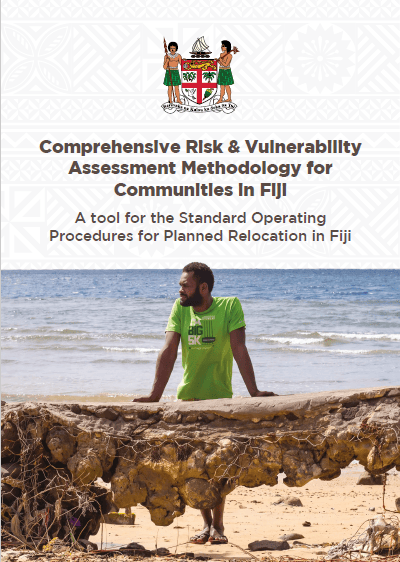
Climate-related hazards are increasing risks to communities, infrastructure, livelihoods, ecosystems and cultural heritage in Fiji. In places where risks are severe, Government decisions need to be informed by a consistent assessment of present and future hazards, the people and assets exposed, and the factors that shape vulnerability. These assessments can help identify appropriate measures to reduce risk and support decisions under Fiji’s planned relocation arrangements.
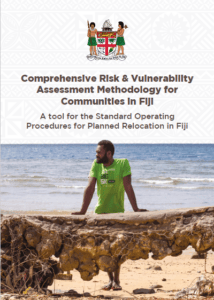
Fiji’s Comprehensive Risk and Vulnerability Assessment Methodology (CRVAM) provides a structured approach for assessing community-level climate risk. Developed under the guidance of the Fiji Taskforce on Relocation and Displacement, with contributions from its technical working group, the methodology is an integral tool supporting the Standard Operating Procedures for Planned Relocation in Fiji. It guides assessment of hazards, exposure and vulnerability; it considers evaluation of current and projected risks; consideration of adaptation measures; and assessment of potential relocation sites.
The CRVAM is designed to support decisions that are evidence-based, transparent and grounded in community context. It treats planned relocation as one possible risk-reduction measure and an option of last resort, after other suitable adaptation measures have been considered. The assessment also reflects a range of consequences, that include impacts on life and health, housing, displacement, livelihoods, property, the environment and cultural heritage.