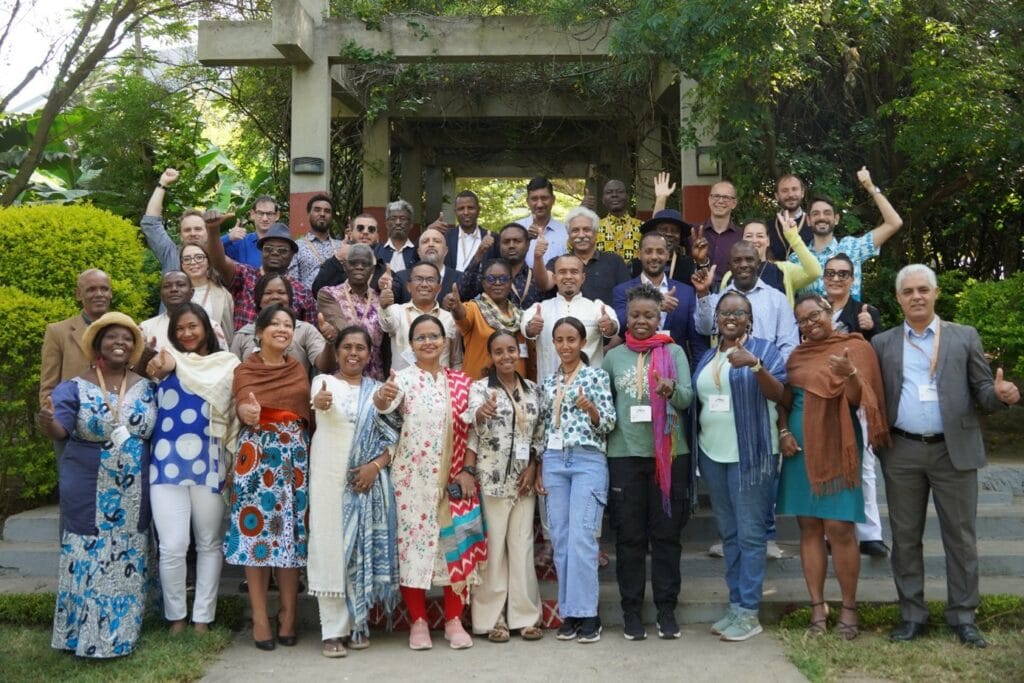
Participants and facilitators of the Agroecology Leadership Academy on the last day of the second international learning event in Hawassa/Ethiopia
Agriculture is crucial for many African economies. However, current agriculture and food systems face challenges due to climate change and non-climatic stresses. To address these issues, increasing resilience of food systems and ecosystems is essential, and an agroecological transition towards sustainable agri-food systems is considered a central task for the future.
The EU-cofunded action “ProSilience” works specifically on this task. It is embedded in the Global Programme “Soil Protection and Rehabilitation for Food Security” (ProSoil), which is commissioned by the Federal Ministry for Economic Cooperation and Development (BMZ), co-funded by the European Union and implemented by the Deutsche Gesellschaft für Internationale Zusammenarbeit (GIZ) GmbH.
ProSilience is being implemented in Benin, Ethiopia, Kenya, and Madagascar. It also includes cross-country activities covering all seven partner countries of ProSoil. Transformative change effort in the context of agroecological transition can only be realized if initiated and sustained by committed and visionary partners in the countries. As drivers of change, they influence and shape the future and have a key role to play in building alliances with other stakeholders, advancing efforts of transition, developing and communicating knowledge around agroecological transitioning.
Implementing change as an individual, requires much more than being highly skilled. A set of tools are needed to be leading such, starting with context-specific recognition of opportunities and limitations, understanding relationship dynamics, building alliances – often with unlikely or untrusted partners – and identifying personal patterns of enabling or hindering change efforts.
The Agroecology Leadership Academy seeks to be the booster to acquire such competences.
Project scope and aim
It aimed to enable nearly 40 selected candidates from seven countries to learn together to better navigate complexity. This empowered them to become leaders for socio-ecological transformation to act purposefully and make a meaningful impact in advancing agroecology locally and globally.
The Agroecology Leadership Academy aimed to bring together a diverse group of people from different backgrounds and skills, also representing gender and youth, with a high level of engagement and willingness to influence and advance agroecological transition processes.
For all participants, both learning and acting happened at three levels: the individual, the country team and the international cohort level over the course of the project.
Timeframe
The Agroecology Leadership Academy took place as a Learning Journey over eleven months from January to November 2024.
Modules of the Agroecology Leadership Academy are being shared with the Agroecology TPP community to support and facilitate such agroecological transitions in other contexts.
Further information and materials of the Academy in English and French