Climate Services in Germany – Stakeholders, Challenges, Factors of Success

Within the German Adaptation Strategy, municipalities in Germany are given a special role in its implementation and that is why they represent one of the largest target groups for Climate Services. The study provides 6 main recommendations for an enhanced provision and use of Climate Services for adaptation planning in Germany.
Assessment of Climate Service Providers Capabilities in Brazil
The Assessment of Climate Service Providers Capabilities in Brazil has been conducted as part of the baseline asssessment for the Climate Service for Infrastructure Investment (CSI) project. It demonstrates that a diverse set of stakeholders exist that provides Climate Services for different sectors and decision making context. The report is in Portuguese.
NAPCC Country Case Study India
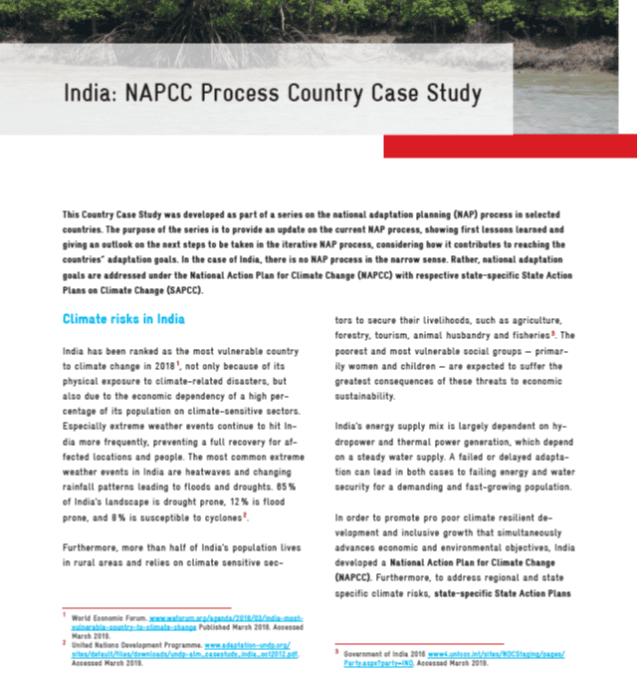
This case study was developed as part of a series on the national adaptation planning (NAP) process in selected countries, looking at specific climate risks as well as the governance structure and policy framework. It provides an update on the current NAP process, showing first lessons learned and giving an outlook on the next steps to be taken in the iterative NAP process, considering how it contributes to reaching national adaptation goals.
The Role of the NAP Process in Translating NDC Adaptation Goals into Action. Linking NAP Processes and NDCs (Arabic Version) – دور إجراءات خطّة التكيُف الوطنية في ترجمة أهداف التكيُف في المساهمات المحددة وطنياً إلى عمل – ربط إجراءات خطّة التكيُف الوطنية بالمسهامات المحددة وطنياً
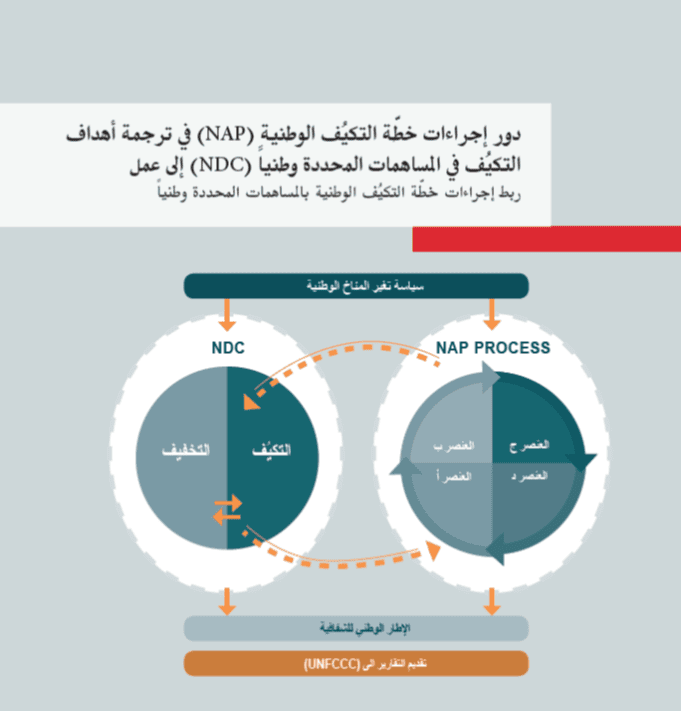
حسب المادة 7.9 من اتفاقية باريس، تشارك جميع األطراف ُف وكما هو مناسب في تكوين وتطبيق إجراءات تخطيط التكي ُلزم ُف الوطنية )NAP). تستهدف هذ الوثيقة صانعي السياسات والقرارات والممارسين ُف مع تغير المناخ على المستوى الوطني )مثال: العاملين في التكي ُف وخبراء وزارات البيئة ونقاط اتصال تغير المناخ وخبراء التكي على مستوى القطاعات.
Planification participative de scénarios d’adaptation pour informer le processus PNA au Bénin
Le présent rapport capitalise les leçons et acquis de l’exercice de planification participative des scenarios d’adaptation, qui a regroupé les acteurs clés des trois secteurs – agriculture, ressources en eau et santé, du secteur transversal de l’environnement, de la gouvernance locale, de la communauté scientifique, de la société civile et du secteur privé dans le cadre de la composante 2 du Projet d’Appui Scientifique aux processus de Plans Nationaux d’Adaptation (PAS-PNA).
Understanding and Increasing Finance for Climate Adaptation in Developing Countries
The study by the Climate Policy Initiative (CPI) and adelphi explores the current state of finance for climate adaptation and proposes practical, near term solutions to both fill in knowledge gaps and to increase investment.
Evaluation de la vulnérabilité du secteur de la zone côtière à la variabilité et aux changements climatiques dans la région de Fatick
Cette étude, réalisée dans le cadre de la composante 2 du Projet d’Appui Scientifique aux processus de Plans Nationaux d’Adaptation (PAS-PNA) porte sur le secteur de la zone côtière et a pour objectif général de mesurer la vulnérabilité face aux changements climatiques de la zone du Delta du Saloum/région de Fatick et d’identifier des options d’adaptation pertinentes.
Evaluation de la vulnérabilité du secteur ressources en eau à la variabilité et aux changements climatiques dans la région de Fatick
Cette étude, réalisée dans le cadre de la composante 2 du Projet d’Appui Scientifique aux processus de Plans Nationaux d’Adaptation (PAS-PNA) porte sur le secteur des ressources en eau et a pour objectif général de mesurer la vulnérabilité face aux changements climatiques de la zone du Delta du Saloum/région de Fatick et d’identifier des options d’adaptation pertinentes.
Evaluation de la vulnérabilité du secteur agricole à la variabilité et aux changements climatiques dans la région de Fatick
Cette étude, réalisée dans le cadre de la composante 2 du Projet d’Appui Scientifique aux processus de Plans Nationaux d’Adaptation (PAS-PNA) porte sur le secteur de l’agriculture et a pour objectif général de mesurer la vulnérabilité face aux changements climatiques de la zone du Delta du Saloum/région de Fatick et d’identifier des options d’adaptation pertinentes.
Etude de Vulnérabilité Sectorielle face aux changements climatiques au Bénin : Santé
Cette étude a été réalisée dans le cadre de la composante 2 du Projet d’Appui Scientifique aux processus de Plans Nationaux d’Adaptation (PAS-PNA) elle présente les données climatologiques, météorologiques, épidémiologiques, entomologiques et socio- économiques issues des bases de données existantes complétées par des enquêtes de terrain dans trois communes de la zone sanitaire Adjohoun-Bonou-Dangbo.
L’ensemble de ces données ont permis de calculer les indicateurs d’exposition, de sensibilité et de capacité d’adaptation et d’évaluer la vulnérabilité de la population par rapport au paludisme.