Using water-focused climate adaptation to strengthen the resilience of water resources and water services in response to the increasing effects of climate change
Using water focused climate adaptation to strengthen the resilience of water resources and water services in response to the increasing effects of climate change.
G-CREWS is delivering infrastructure upgrades, loss-reduction measures and strengthened governance. Long term, these interventions feed into Grenada’s investment-ready National Adaptation Plan (NAP) pipeline, improve the country’s climate resilience profile, and create foundations for continued private and public investment in adaptation. This is key to ensuring water security remains central to Grenada’s climate future.
The project is jointly financed by the Green Climate Fund (GCF) and the German Federal Ministry for the Environment, Climate Action, Nature Conservation and Nuclear Safety (BMUKN) under its International Climate Initiative (IKI) and the Government of Grenada. It is implemented by the Government of Grenada, the Grenada Development Bank and the National Water and Sewage Authority (NAWASA) in partnership with the German Development Corporation (GIZ).
The G-CREWS project aims to enhance climate resilience in Grenada’s water sector through a comprehensive transformation at various levels, fostering a paradigm shift for overall national resilience.
From proposal development and inception, G-CREWS aligned with the National Adaptation Plan and the National Water Policy. Priorities and actions were shaped through comprehensive stakeholder consultations, ensuring that measures respond to nationally defined needs and enjoy broad ownership. Using an integrated water resources management lens, the project addresses governance and regulation, demand-side management, infrastructure resilience, private sector engagement, and the water sector’s contributions to wider climate objectives such as renewable energy use, disaster risk management, and ecosystem-based approaches.
G-CREWS has become a cornerstone in preparing and operationalizing Grenada’s NAP 2025–2030, translating national strategy into concrete sector action. It tackles a recognized national priority: chronic water scarcity exacerbated by rising temperatures, erratic rainfall with turbidity spikes, and sea-level–driven saltwater intrusion. These threats cut across public health, agriculture, tourism, and economic stability. By securing and managing water resources more effectively, G-CREWS unlocks cross-sector co-benefits and strengthens institutional capacity, making the NAP more actionable and financeable.
Water-sector improvements under G-CREWS support other NAP Programmes of Action: climate-smart agriculture, health systems, disaster preparedness, and ecosystem protection by ensuring reliable access to freshwater and resilient infrastructure. The project also embeds equity and inclusion alongside technical measures, advancing the NAP’s people-centered ambition and reinforcing human security at the community level.
G-CREWS successfully developed and applied a suite of complementary approaches and tools that advanced Grenada’s water-sector resilience:
A holistic integrated water resources management framework linked governance, infrastructure, demand management, private sector engagement and cross sectoral climate objectives. G-CREWS catalyses transformational change by addressing and tackling the issues of supply, demand, climate resilience and mitigation simultaneously.
A clear theory of change guided by a logical framework established targets and impact pathways across individual, organizational and institutional levels, including:
These layers create a reinforcing feedback loop between supply, demand and regulation.
A key cross-cutting measure involves mainstreaming climate resilience and water into the policies and regulations of diverse sectors like health, education and housing, ensuring that water-efficient standards are legally embedded. A theme of the project is the integration of rainwater harvesting as an instrument to promote the goal of a decentralized water supply for commercial, industrial and residential users. For instance, the project aligned with national education priorities, created a replicable model for integrating climate education from pre-primary through tertiary levels, reaching an estimated 11,000 children, and broadening public ownership of adaptation.
Private sector cooperation plays a pivotal role, particularly within the Challenge Fund for Tourism and Agriculture. The fund provides grants that incentivise significant private co-finance for water-efficient equipment and rainwater harvesting (RWH), demonstrating technical and economic feasibility. All major banks in Grenada have collaborated with the project to adapt their green loan programmes to include recommendations for water efficiency and RWH systems.
Furthermore, a proposal for a two-year temporary concession (zero-rated VAT and duty-free) on importing Water Efficient Devices (WEDs) is designed to lower costs for retailers and increase consumer adoption. Amendments to the Consumer Protection Act aim to protect the public from “greenwashing” and misleading efficiency claims, ensuring that retailers provide accurate information about the sustainable products they sell.
In the public sectors, selected schools receive additional water storage and RWH systems and are linked with agricultural school projects. Selection criterion are e.g. existing status as emergency shelters, storage capacity or intensity of supply interruptions. Eleven (11) health centers received additional potable water storage to allow for continued operation even during extreme weather events.
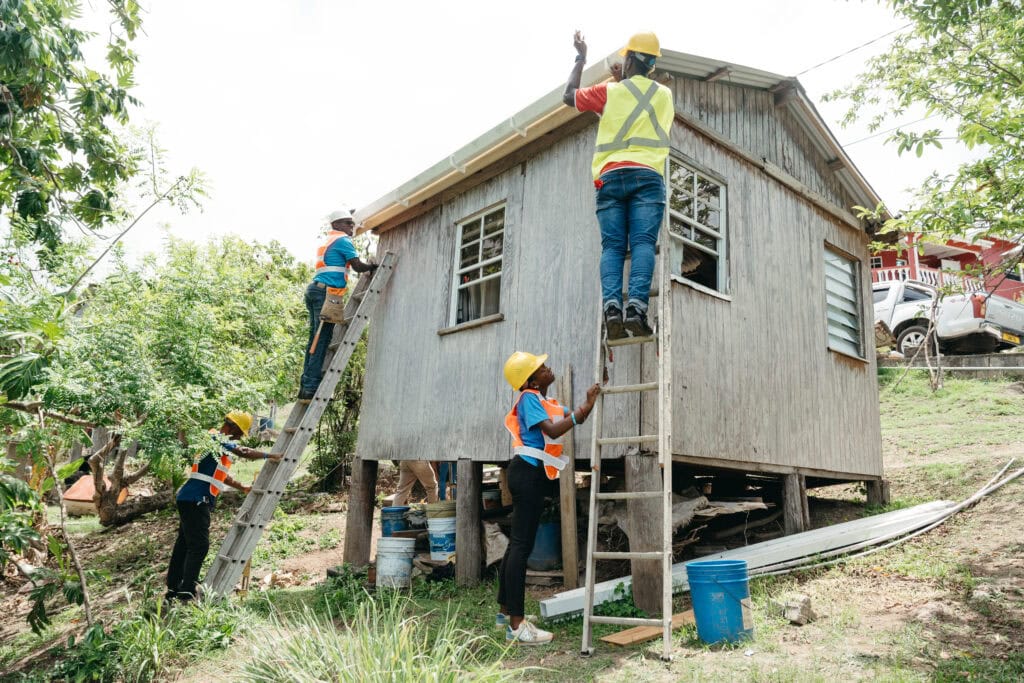
To support the nation-wide dissemination and adoption capacity of water efficient and RWH technologies, the project updated vocational curricula for plumbers, creating a skilled workforce capable of maintaining the new climate-resilient systems.
The G-CREWS project fosters extensive civil society and stakeholder engagement through inclusive governance and transparent feedback mechanisms. For instance, the development process for the new RWH regulations involved multiple rounds of stakeholder consultations to ensure that the legislation reflects broader community needs. Furthermore, the project supported the Ministry of Climate Resilience in the creation of the https://climateresilience.gov.gd/ website, a centralized “one-stop hub” for climate-related research, funding opportunities, and project databases.
More than EUR 22 million of the project funds are directly allocated for climate-resilient water infrastructure for the sole water utility serving the tri-island state. Using vulnerability assessments, hydrological modelling and climate data projections, the project identified priority interventions for the water-supply sector.
Major infrastructure works include the design and erection of eight hurricane-resistant, glass-fused water tanks and about 26 km of ductile-iron pipelines; a transformational cross-island water-transfer system conveying water from the Great River on the east to augment scarce supply in the densely populated southern and western regions of the island; integration of solar photovoltaic generation into the system; and a community-scale rainwater harvesting system in Carriacou.
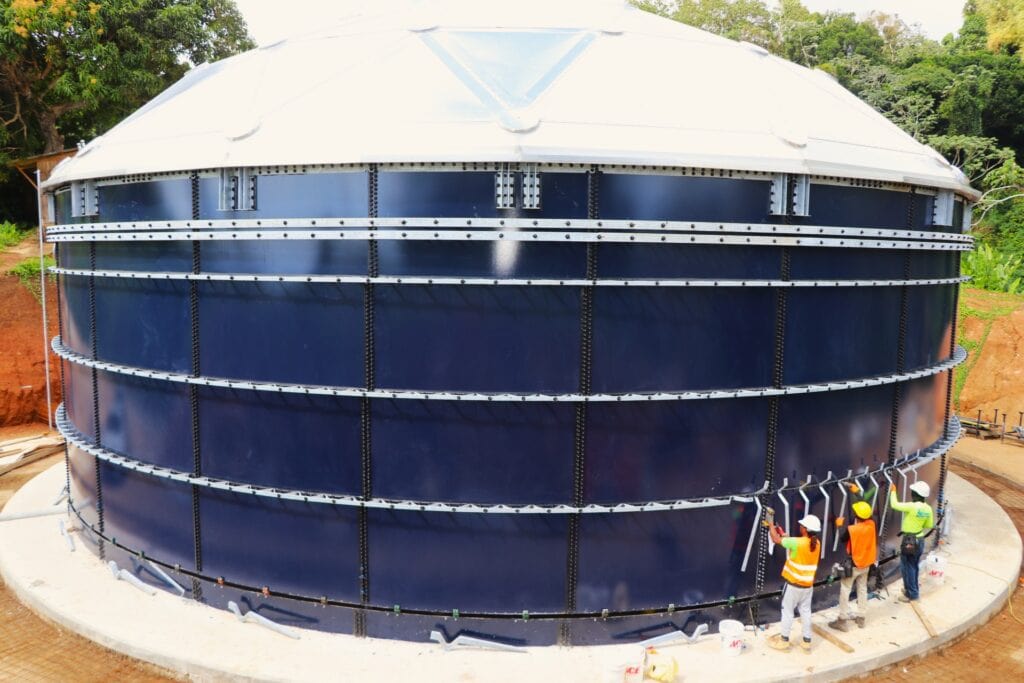
The project incorporated Occupational Safety and Health (OSH) and environmental safeguards by implementing a comprehensive OSH program and manual and by preparing site-specific Construction Environmental and Social Management Plans (C-ESMPs) for major works. A robust emergency response and disaster-management plan and capacity building programme was rolled out to protect staff and maintain service continuity during climate events.
To reduce losses and modernize operations, G-CREWS supported NAWASA in creating a dedicated non-revenue water unit, installing remote monitoring (SCADA), and deploying a centralized, innovative IT management system for utilities, bringing NAWASA into a modern era of digital operation with a single GIS-supported database for managing data and processes.
A key success factor is that all involved stakeholders and implementing partners have played some part in the development of the project. The National Water and Sewage Authority (NAWASA) as one of the main beneficiaries has contributed to the proposal through information gathering and provision, sharing of experience, reviews as well as direct consultations with the GCF Secretariat.
The GCF funded major infrastructure and end-user equipment; BMUKN/ IKI focused on mitigation and the climate–water–energy nexus, including renewable energy investments and regional replication through knowledge management and concept-note development.
The co–financing structure fostered learning between donors, enhancing complementarity and regional replication potential and is benefitting from a donor dialogue that brings representatives from the GCF Secretariat, the German Environmental Ministry and the Government of Grenada together three times during the lifetime of the project to directly exchange on strategic areas.
Project governance featured an active Project Management Committee (meeting weekly, then biweekly) and high-level steering and oversight committees in the form of the Project Steering Committee for risk oversight. The integrated approach of the G-CREWS project allows to tackle all major aspects of water management in Grenada from all angles and all relevant sectors. The intensive focus on the sector for over half a decade results in a strong ownership and awareness in within the different demographics in Grenada, Carriacou and Petite Martinique. The exit strategy of the project serves as a tool to plan the sustainable impact of the G-CREWS project and is regularly updated to “keep an eye” on the time after the project is officially completed and to foster long-term gains.
The project highlighted the need for foresighted budgeting that accounts for inflation, currency risk, feasibility contingencies and environmental and social safeguard costs and for realistic procurement timelines. Lessons led to recommendations for built-in buffers, flexible consultancy budgets, and clearer partner roles to reduce delays and rework. Institutional and governance disruptions early in the project required formal corrective actions such as developing an operational manual, signing Memorandums of Understanding, and appointing focal points which consumed staff time and delayed momentum while the revised structures were being put in place.
Data quality and water and climate data management weaknesses significantly undermined planning and monitoring. Source datasets were often missing, incomplete, or inaccurate; multiple currencies and inconsistent metrics complicated data processing and aggregation; and there was no established organizational culture or standardized process for managing, validating, and utilizing project data.
Additionally, delays in adjusting the water tariff created a financial risk for long-term asset sustainability: if tariffs are not updated in a timely manner, much larger increases may be required later to cover ongoing operation and maintenance costs for newly installed infrastructure. Initial feasibility assessments and the subsequent expectations set were sometimes inadequate, which necessitated additional planning, adaptive management, and the use of buffer funds during implementation; stronger up-front dialogue and clearer partner role definitions could have reduced the need for costly mid-course corrections.
The Challenge Fund’s setup proved to be too detailed and resource-intensive for small-scale businesses in Grenada. The reimbursement-style grant model was not feasible for either the hotel or agricultural sectors, so the project team had to adapt how grants were disbursed and how equipment was provided (e.g. in bulk procurement). Local access to self-procured equipment is limited, and a feasibility study should have assessed the capacity of local retailers, spare-parts suppliers, and installers. Finally, the unclear and labor-intensive coordination within the multiple organizations, and external consultants making up the Challenge Fund implementation team consumed substantial time and resources.
Guided by a communication Strategy, operational Plan and a working group made up of communication officers from all major project partner organizations, the G-CREWS awareness, education and outreach efforts span several channels to effectively disseminate the information to the population.
These public engagements include:
A quick glance to much of these can be found via these YouTube and Linktree links The G-CREWS Project Overview of Components G-CREWS | Instagram, Facebook | Linktree
Selected products are:
Marion Geiss
Climate-Resilient Water Sector in Grenada (G-CREWS)
Head of Project (GIZ)
Deutsche Gesellschaft fuer Internationale Zusammenarbeit (GIZ) GmbH
+1 473 419-8000
Skype: marion.geiss@giz.de (marion.geiss)
I www.giz.de and https://climateresilience.gov.gd
To get all the latest news like us on social media
You are currently viewing a placeholder content from Vimeo. To access the actual content, click the button below. Please note that doing so will share data with third-party providers.
More InformationYou are currently viewing a placeholder content from YouTube. To access the actual content, click the button below. Please note that doing so will share data with third-party providers.
More InformationYou need to load content from reCAPTCHA to submit the form. Please note that doing so will share data with third-party providers.
More InformationYou need to load content from reCAPTCHA to submit the form. Please note that doing so will share data with third-party providers.
More InformationYou are currently viewing a placeholder content from Google Maps. To access the actual content, click the button below. Please note that doing so will share data with third-party providers.
More InformationYou are currently viewing a placeholder content from Google Maps. To access the actual content, click the button below. Please note that doing so will share data with third-party providers.
More InformationYou are currently viewing a placeholder content from Mapbox. To access the actual content, click the button below. Please note that doing so will share data with third-party providers.
More InformationYou are currently viewing a placeholder content from OpenStreetMap. To access the actual content, click the button below. Please note that doing so will share data with third-party providers.
More InformationYou are currently viewing a placeholder content from reCAPTCHA. To access the actual content, click the button below. Please note that doing so will share data with third-party providers.
More Information