What are you looking for?

Training Course “Valuing the benefits, costs and impacts of Ecosystem-based Adaptation (EbA) measures”

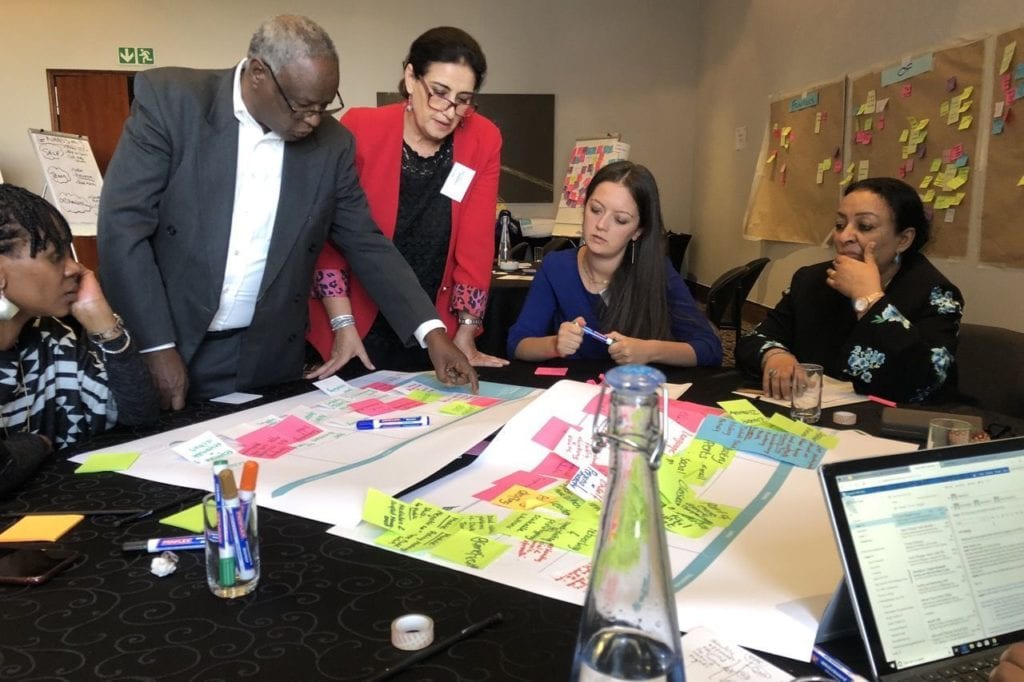
Five people discuss a transcript at a table
© GIZ / Sean Germond, Sophia Birchinger


The objective of the training is to build awareness and knowhow about why, how and in which contexts EbA assessment and valuation can be used to strengthen climate adaptation planning and implementation in different decision-making contexts.

Using a mixture of interactive lectures, open discussions, group work, case studies and real-world examples, the envisaged learning outcomes are that, by the end of the module, participants:

  • Will be able to identify why, when and how valuation studies can be useful for particular purposes and decision-making contexts;
  • Will have become familiar with (but not necessarily able to apply) a range of socio-economic assessment and valuation methods;
  • Will have shared various tools and approaches for enhancing the strategic impact of valuation studies on real-world decision-making; and
  • Will be better-equipped to oversee processes to design, commission, manage and use the results of EbA valuation studies.


Content:

The valuation training is designed as an add-on module to the GIZ course “Mainstreaming Ecosystem-based Adaptation (EbA) to Climate Change into Development Planning”, Its duration is approximately 2.5 days, although the content be shortened or lengthened as needed (for example a field trip and/or additional group work can be incorporated, and one or two ‘cornerstone’ lectures can be extracted as summaries).

The course is divided into three components, seven lectures and five case study/group work sessions.

  • Identifying needs, opportunities & frameworks for EbA valuation goes over the basics of valuation (key terms, concepts and categories) and focuses on defining the purpose of valuation studies (why and when to value EbA benefits, costs and impacts) and;
  • Choosing valuation methods addresses key issues, approaches and methods for valuing EbA biophysical effects, risk exposure and vulnerability, economic costs and benefits, livelihood and wellbeing impacts, social and institutional outcomes;
  • Delivering decision-support looks at tools and approaches that can be used to enhance the strategic impact of valuation, and leverage decision change. It also works with participants to identify how valuation can be taken forward in the context of their own work.


The Global Project Mainstreaming EbA ended in February 2023, but training materials can be made available upon request. Please reach out to the Sector Programme Climate and Climate Policy for information regarding the EbA trainings.

Recent Trainings

E-Learning sur la mobilité humaine dans le contexte des changements climatiques

Dans ce cours interactif à l’auto-rythme, qui a été développé en coopération entre le Programme mondial « Mobilité humaine dans le contexte des changements climatiques » de la GIZ et l’Université des Nations Unies – Institut pour l’Environnement et la Sécurité Humaine (UNU-EHS), les décideurs politiques, les professionnels du développement, les chercheurs et les étudiants apprendront comment les changements climatiques influencent la mobilité humaine. En introduisant des concepts clés tels que la migration liée au climat, le déplacement en cas de catastrophe, la relocalisation planifiée et les populations piégées, cette formation développera les capacités nécessaires pour envisager la mobilité humaine liée aux changements climatiques (MHCCC) dans votre domaine de travail respectif. La formation présente des exemples variés de différents pays sur le phénomène du MHCCC ainsi que des options pour les gérer.

Read More »

Transforming our Disaster Risk Lens: From response to prevention

Disasters are becoming more frequent, more intense, and increasingly interconnected. Building resilience requires collaboration across governments, communities, civil society, and the private sector. This course introduces the foundations of disaster risk management (DRM) and explores how risk considerations can be systematically integrated into development planning and decision-making.

Read More »
A comic-style illustration featuring the words ‘Knowledge for all’, showing an African woman called Amina holding a tablet.

Building Resilient African Cities: Join Amina’s Journey Through Risk-Informed Urban Development (RIUD)

In this interactive, story-driven course, learners accompany Amina, an urban development specialist, on a mission across Africa. She explores how communities, local governments, and practitioners are addressing urban risks and building resilience in diverse contexts. The course provides practical knowledge and tools to help urban planners, policymakers, and development practitioners integrate climate risk considerations into urban development processes, contributing to safer, more resilient, and sustainable cities across Africa.

Read More »