What are you looking for?

Publications

Here you can find publications on the subject of climate change adaptation in different languages. Please use the filter option to select your preferred language.
  • Topics

  • Types

  • Languages

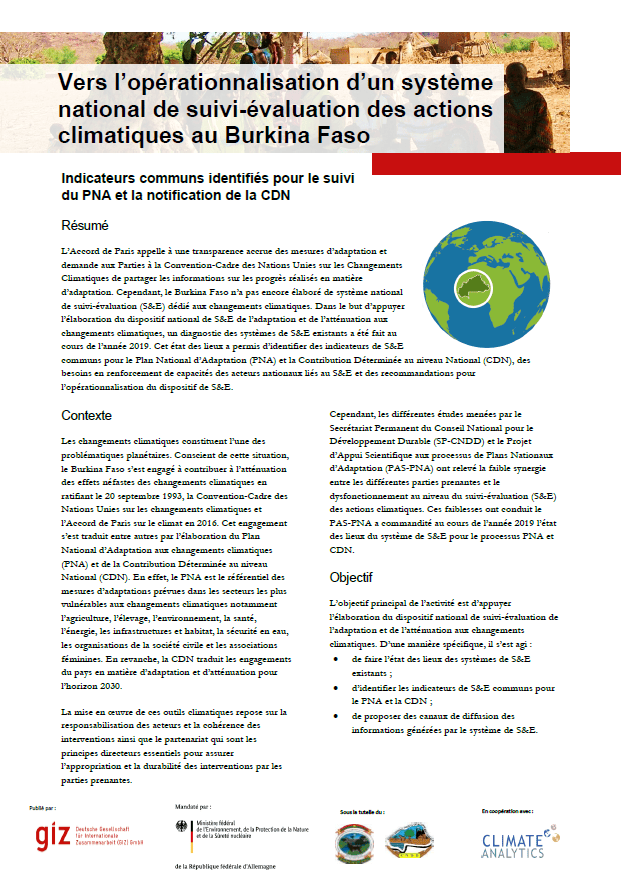
Dans le but d’appuyer l’élaboration du dispositif national de S&E de l’adaptation et de l’atténuation aux changements climatiques, un diagnostic des systèmes de S&E existants a été fait au cours de l’année 2019. Cet état des lieux a permis d’identifier des indicateurs de S&E communs pour le Plan National d’Adaptation (PNA) et la Contribution Déterminée au niveau National (CDN), des besoins en renforcement de capacités des acteurs nationaux liés au S&E et des recommandations pour l’opérationnalisation du dispositif de S&E.
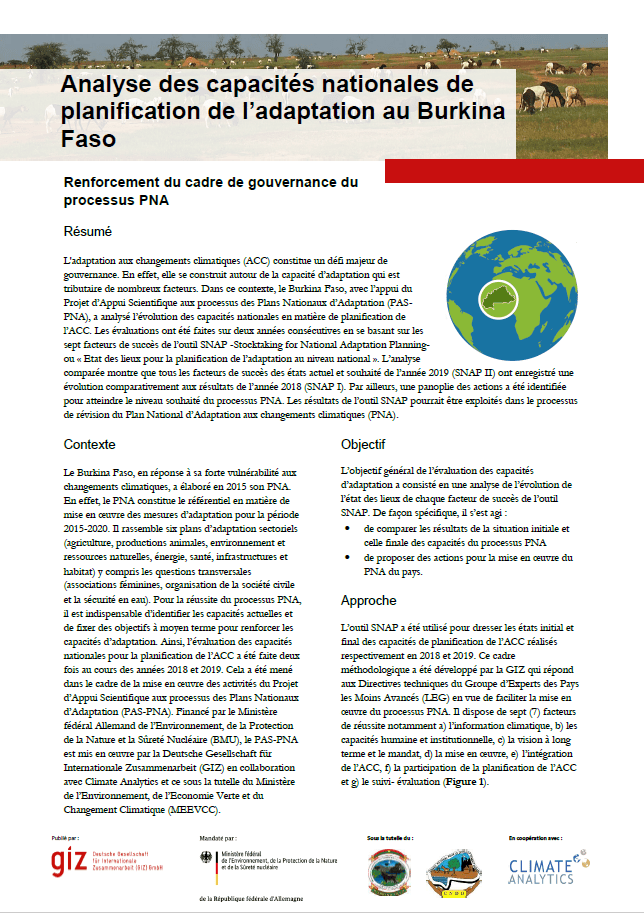
Le Burkina Faso a analysé l’évolution des capacités nationales en matière de planification de l’ACC. Les évaluations ont été faites sur deux années consécutives en se basant sur les sept facteurs de succès de l’outil SNAP -Stocktaking for National Adaptation Planning- ou « Etat des lieux pour la planification de l’adaptation au niveau national ».
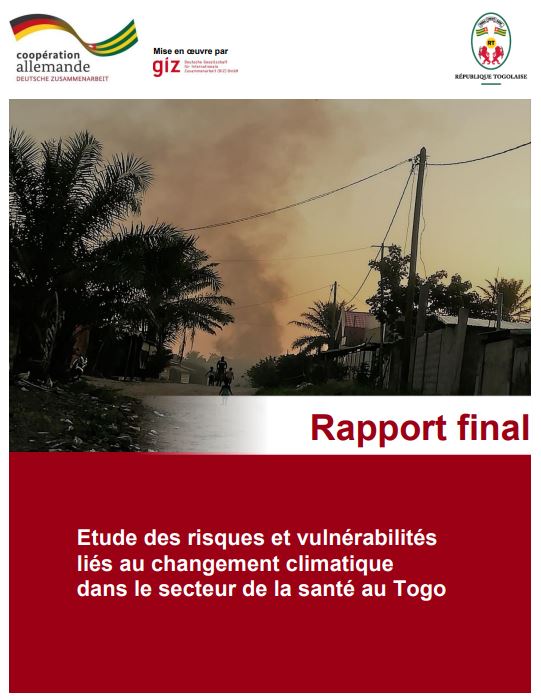
Bien que les effets du changement climatique sur la propagation des maladies à transmission vectorielle, hydrique et infectieuse soient bien établis ailleurs, le Togo ne disposait pas encore d’une évaluation concluante de sa vulnérabilité. En 2019, le ministère de la Santé et de l’Hygiène publique, avec le soutien du projet ProSanté de la GIZ, a analysé les impacts des risques climatiques sur le risque de paludisme, de méningite et d’infections respiratoires.
Bien que les effets du changement climatique sur la propagation des maladies à transmission vectorielle, hydrique et infectieuse soient bien établis ailleurs, le Togo ne disposait pas encore d'une évaluation concluante de sa vulnérabilité. En 2019, le ministère de la Santé et de l'Hygiène publique, avec le soutien du projet ProSanté de la GIZ, a analysé les impacts des risques climatiques sur le risque de paludisme, de méningite et d'infections respiratoires.
Although the effects of climate change on the spread of vector-borne, water-borne and infectious diseases are well established elsewhere, Togo was yet missing a conclusive vulnerability assessment. In 2019, the Ministry of Health and Public Hygiene with support of the GIZ-Project ProSanté analysed the impacts of climate hazards on the risk of malaria, meningitis and acute respiratory infections.
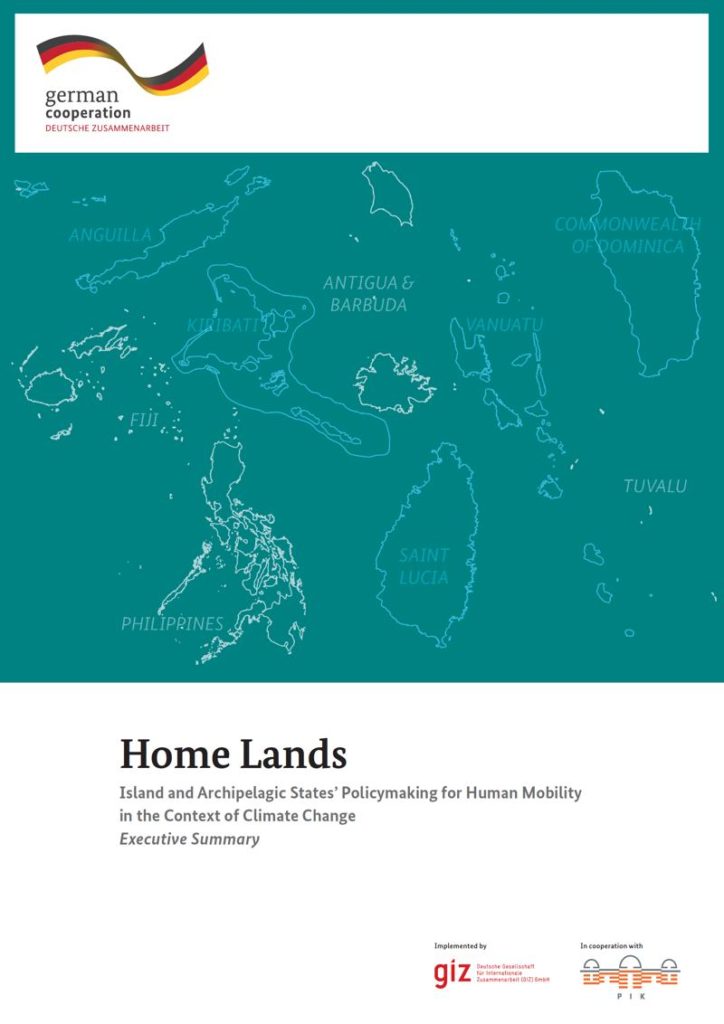
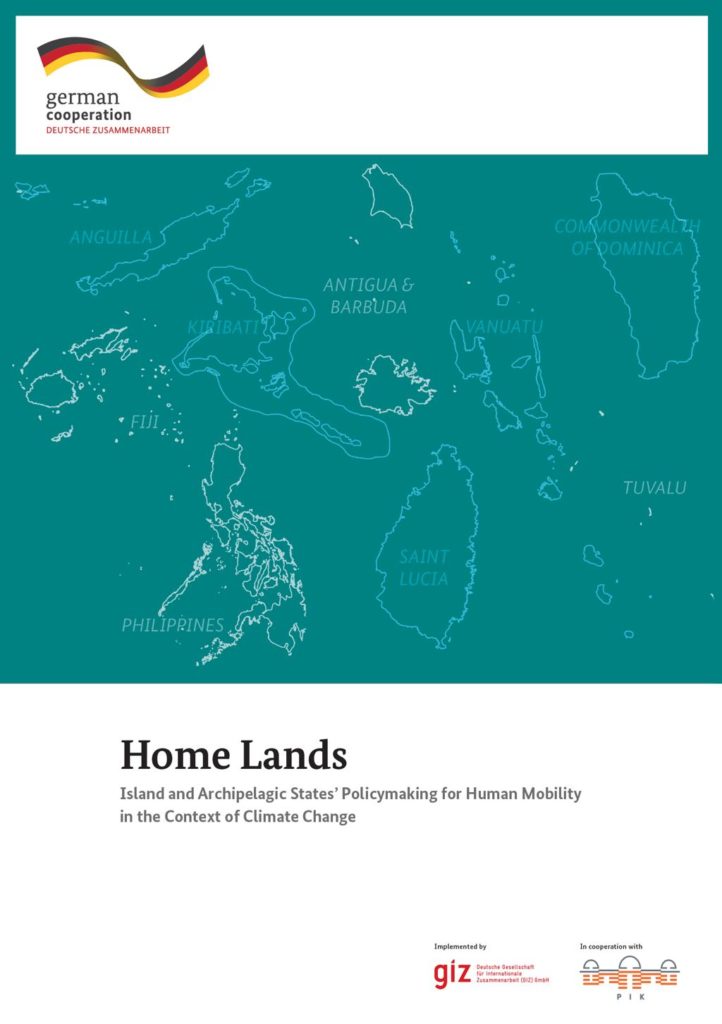
This report provides an overview of how human mobility in the context of climate change (HMCCC) fits into the policy landscape of nine island and archipelagic countries: Anguilla, Antigua & Barbuda, Dominica, and St. Lucia in the Eastern Caribbean; Fiji, Kiribati, Tuvalu, and Vanuatu in the South Pacific; and the Philippines in the Western Pacific. All of these nations are heavily affected by climate impacts like sea level rise, ocean acidification, tropical cyclones and hydrological extremes.
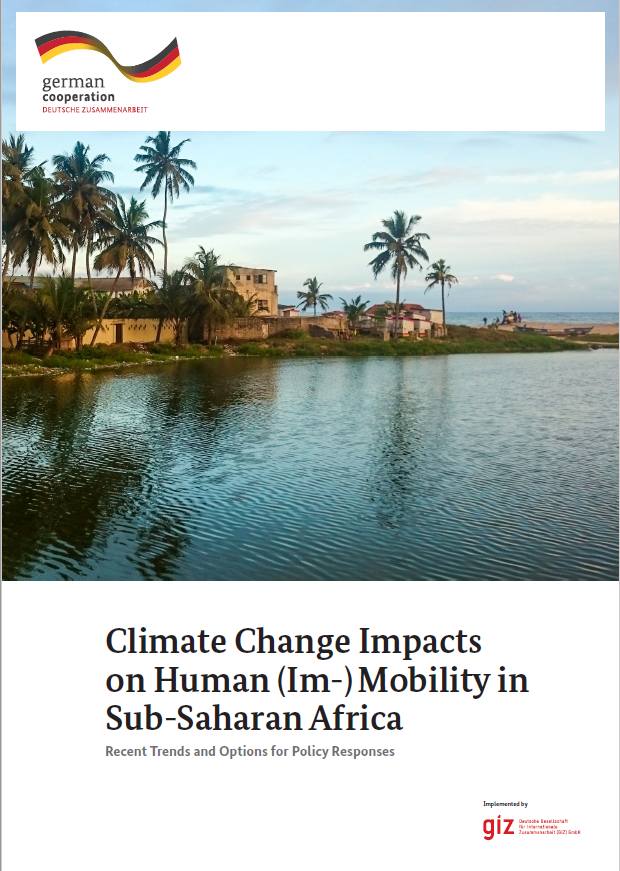
This study examines the negative effects of climate change and how they relate to human mobility in designated countries located in East, West and Southern Africa.
This Adaptation Briefing presents a compilation of selected knowledge products that have been funded by the GIZ “Support Project for the Implementation of the Paris Agreement (SPA)”. The SPA project strengthens several global initiatives and networks co-founded or financially supported by the German Federal Ministry for the Environment, Nature Conservation and Nuclear Safety (BMU) that enhance partner countries’ capacities to successfully implement their climate policies, reduce greenhouse gases, increase their adaptive capacities as well as communicate this transparently.