Down to earth – why soils play a key role in ecosystem based adaptation?
The GIZ Global Project Mainstreaming EbA is happy to share with you the with you the recording of the online session on the key role that soils play in ecosystem-based adaptation.
Why working with nature pays off: The case for investing in Ecosystem-based Adaptation
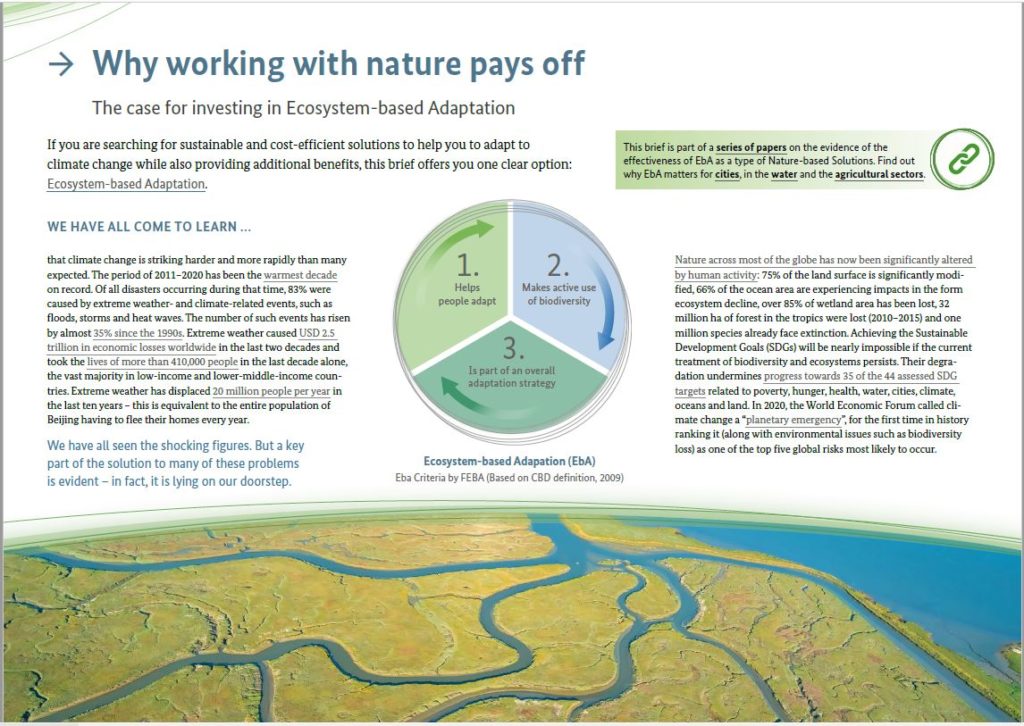
This series of papers compiles arguments, facts and examples on the evidence of the effectiveness of EbA in the form of short, easy to read briefs.
Looking first at why EbA pays off in general, then at EbA in the water sector, in agriculture and in cities, it showcases why EbA offers cost-efficient solutions for adaption to climate change while also providing additional benefits for people and nature.
Each of the four briefs can also be used as a stand-alone document e.g. when discussing adaptation options with planners and decision makers in water management, land use or urban planning.
Solutions in Focus – Key Themes for Ecosystem-based Adaptation
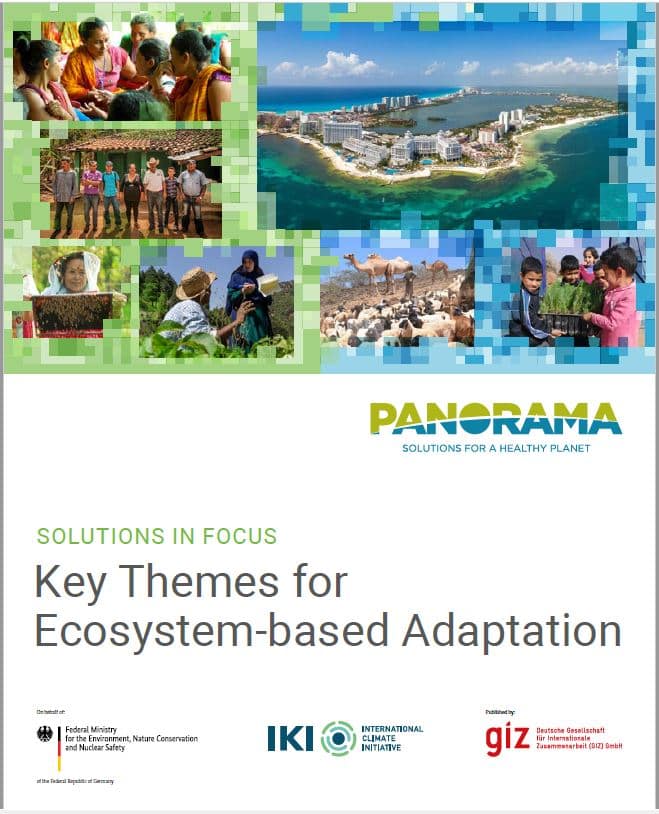
This publication intends to inspire policy- and decision-makers as well as practitioners by showcasing a selection of solutions that have been applied in very different settings and focusing on key aspects and themes that are important for the longevity of EbA. It shows that EbA has ‘many faces’: it is being implemented successfully in a broad range of countries and ecosystems and it is driven forward by all kinds of people and organisations.
Thematic Paper 6: Delivering Financing for Joint Biodiversity and Climate Solutions

Thematic Paper 6 emphasises the need for more coordinated joint climate and biodiversity funding at the international and national levels and outlines examples of possible sources of finance.
Thematic Paper 5: From National to Local Implementation: A Collaborative, Multi-Level Effort to Achieve Joint Climate and Biodiversity Goals

Thematic Paper 5 makes the case for collaborative and inclusive multi-level governance systems to achieve joint climate and biodiversity goals.
Thematic Paper 4: Good Governance for Integrated Climate and Biodiversity Policy Making (updated 05/26)

Thematic Paper 4 analyses the role of good governance for integrated climate and biodiversity policy-making.
Thematic Paper 3: Nature-Based Solutions: An Approach for Joint Implementation of Climate and Biodiversity Commitments (updated 05/26)

Thematic Paper 3 unpacks the concept of Nature-based Solutions (NbS) as an approach for the joint implementation of climate and biodiversity commitments.
Thematic Paper 2: Linkages Between Biodiversity and Climate Change and the Role of Science–Policy–Practice Interfaces for Ensuring Coherent Policies and Actions (updated 05/26)

Thematic Paper 2 highlights that climate change and biodiversity loss are not separate challenges, but two sides of the same global crisis. It emphasizes the need for coherent and integrated policies that align climate adaptation, mitigation, and biodiversity goals across national planning processes. The paper also explores how science can support decision-making by providing knowledge, tools and methods needed to identify trade-offs, unlock synergies, and guide effective action.
‘Down to earth – why soils play a key role in ecosystem-based adaptation
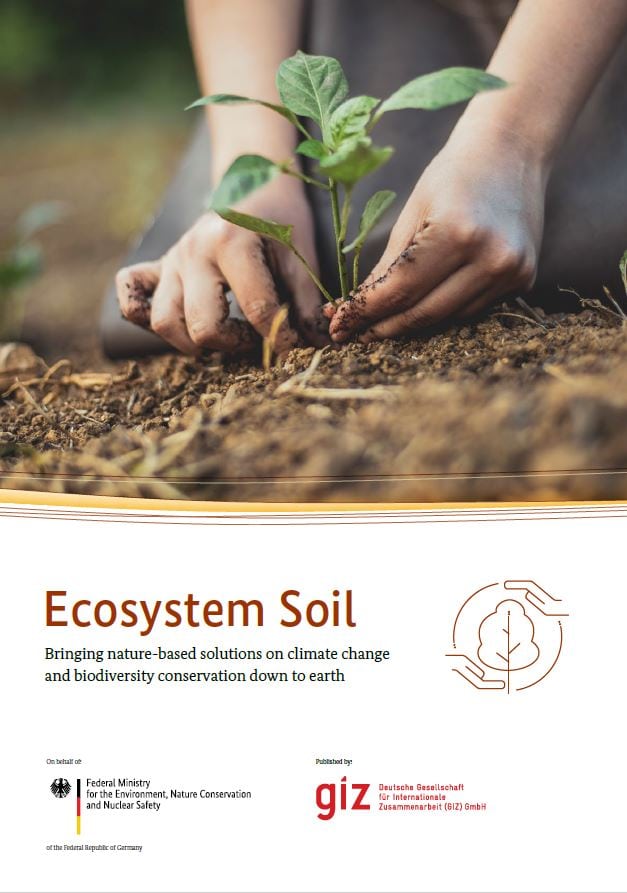
There is an unprecedented interest in nature-based solutions for climate change mitigation and adaptation. But something very important is often missing from discussions of such solutions: the role of healthy soils. As habitats for plants and animals, as regulators of climate and water, and as the foundation of terrestrial ecosystems and the vast majority of our food production, soils are critical to all ecosystem services – including those that humans depend on for survival.
This guidebook aims to demonstrate the importance of sustainable soil management (SSM) for adaptation to climate change, biodiversity conservation and the achievement of long-term food security. By adopting nature-based solutions such as ecosystem-based adaptation (EbA), farmers can dramatically increase their productivity while adapting to climate risks.
The Value of Reefs for Protecting the Most Vulnerable Populations in the Dominican Republic, Jamaica and Grenada
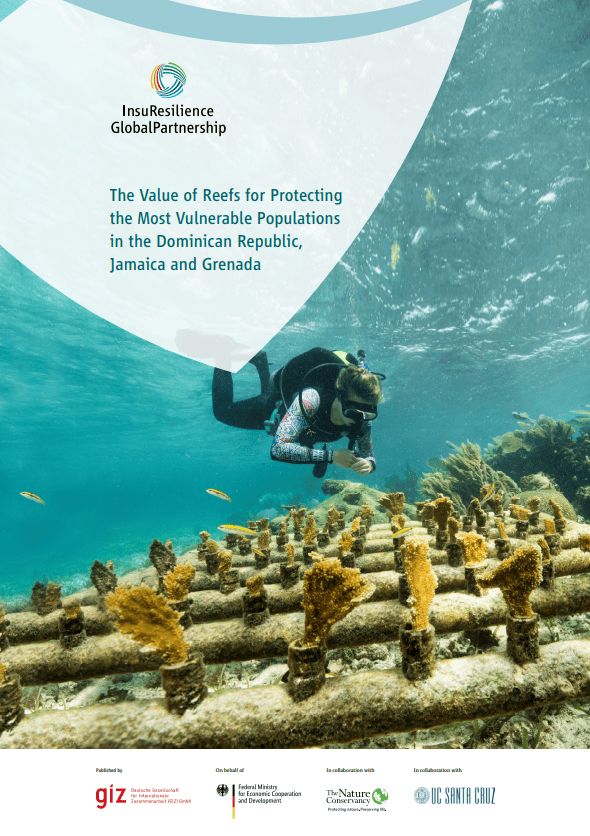
The quantitative, spatially-explicit analyses applied in this study highlight where reefs provide the greatest flood protection services to vulnerable populations in DR, Jamaica and Grenada. This work identifies where future reef loss may have the greatest impacts on vulnerable populations and where enhanced conservation and restoration will deliver the most benefits.