Thematic Paper 2: Linkages Between Biodiversity and Climate Change and the Role of Science–Policy–Practice Interfaces for Ensuring Coherent Policies and Actions (updated 05/26)

Thematic Paper 2 highlights that climate change and biodiversity loss are not separate challenges, but two sides of the same global crisis. It emphasizes the need for coherent and integrated policies that align climate adaptation, mitigation, and biodiversity goals across national planning processes. The paper also explores how science can support decision-making by providing knowledge, tools and methods needed to identify trade-offs, unlock synergies, and guide effective action.
Assessment of Climatic Impact Drivers in India
This assessment describes seven important climatic impact drivers for India, with a special focus on the districts Ahmadnagar, Amravati, Dhule, Jalna and Yavatmal in the state of Maharashtra and Mandla and Balaghat in the state of Madhya Pradesh. It shows how the climatic impact drivers are projected to change under two climate change trajectories in the future (2030, 2050 and 2080).
Assessment of Climatic Impact Drivers in Kenya
This assessment describes seven important climatic impact drivers for Kenya, with a special focus on the counties Bungoma, Kakamega and Siaya. It shows how the climatic impact drivers are projected to change under two climate change trajectories in the future (2030, 2050 and 2080).
Assessment of Climatic Impact Drivers in Ethiopia
This assessment describes seven important climatic impact drivers for Ethiopia, with a special focus on the regions Afar; Amhara; Oromia; Southern Nations, Nationalities, And Peoples´ Region (SNNP) and Tigray. It shows how the climatic impact drivers are projected to change under two climate change trajectories in the future (2030, 2050 and 2080).
Addressing Climate Change Through Integrated Responses: Linking adaptation and mitigation
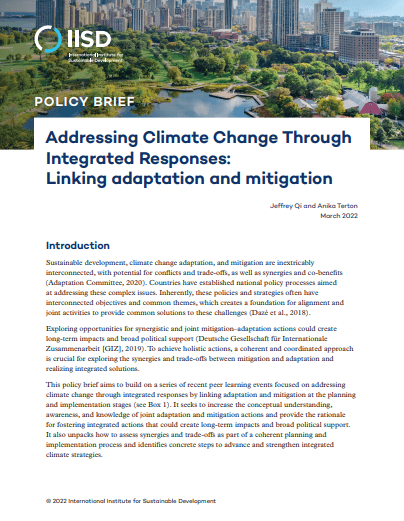
Sustainable development, climate change adaptation, and mitigation are inextricably interconnected, with potential for conflicts and trade-offs, as well as synergies and co-benefits. This policy brief aims to build on a series of recent peer learning events focused on addressing climate change through integrated responses by linking adaptation and mitigation at the planning and implementation stages.
Factsheet: Climate and Disaster Risk Finance in the IPCC Sixth Assessment Report
This factsheet sheds light on the IPCC’s assessment of the role of Climate and Disaster Risk Finance and Insurance global climate change adaptation. It summarizes the key messages on CDRFI in Working Group II’s contribution on Impacts, Adaptation and Vulnerability to the IPCC’s Sixth Assessment Report (AR6).
Gender and Climate Change Adaptation in the NDCs – Policy Paper
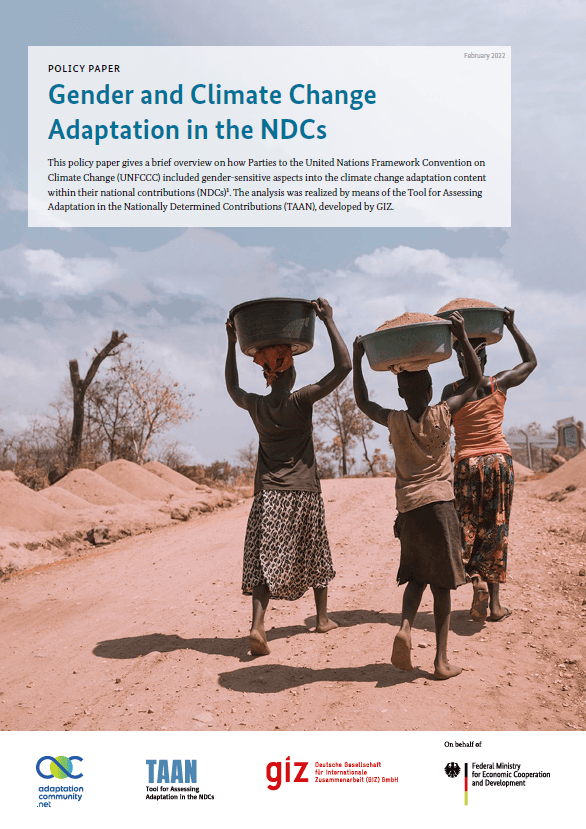
The policy paper offers an analysis of the gender data held in the Tool for Assessing Adaptation in the Nationally Determined Contributions (TAAN), calling attention to gender-sensitive planning processes, gender-disaggregated impacts as well as gender-responsive budgeting approaches.
Digital solutions for small-scale farming: Fostering climate resilient and low carbon agrifood systems
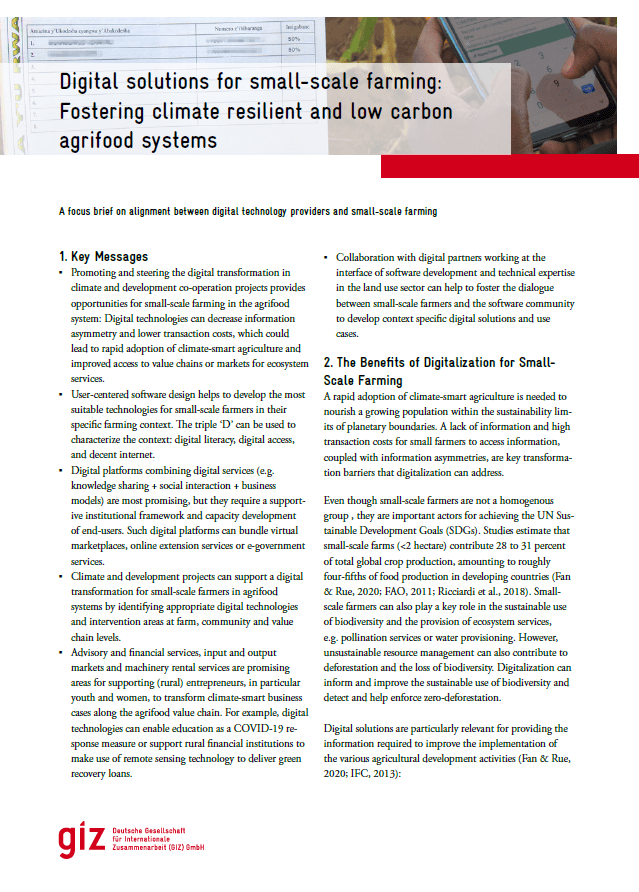
A brief on alignment between digital technology providers and small-scale farming. This complementary publication to the Overview brief presents in more detail the approach to assess and adopt digital technologies that support smallholder farming.
Gestión de riesgos climáticos – Trayectorias prometedoras para evitar, reducir al mínimo y afrontar las pérdidas y los daños
El marco de GRC del GP L&D es un enfoque iterativo basado en riesgos, dirigido a gestionar los riesgos climáticos considerando aspectos sociales, económicos, no económicos, institucionales, biofísicos y medioambientales. Este enfoque entiende las medidas de mitigación, adaptación al cambio climático y reducción del riesgo de desastres, así como la financiación y los seguros de riesgos, como partes complementarias de la misma caja de herramientas. A fin de obtener la combinación de medidas más inteligente posible para una situación dada, se enlazan de manera exhaustiva e integrada medidas avaladas en la práctica con instrumentos innovadores y enfoques transformadores.
Gestion des risques climatiques – Des voies prometteuses pour éviter les pertes et préjudices, les réduire au minimum et y remédier
Le cadre de GRC du PM P&P (voir Figure 1) est une approche itérative, fondée sur le risque, de gestion des risques liés au climat, qui tient compte des aspects sociaux, économiques, non économiques, institutionnels, biophysiques et environnementaux. Il considère les mesures liées à l’atténuation, à l’adaptation au changement climatique, à la réduction des risques de catastrophes, au financement des risques et à l’assurance risques comme des éléments complémentaires d’une même boîte à outils. Afin de disposer de l’ensemble le plus efficace de mesures pour une situation donnée, il associe des mesures éprouvées à des instruments innovants et des approches transformationnelles, de manière globale et intégrée.