Factsheet: Explanation of terms EbA and NbS
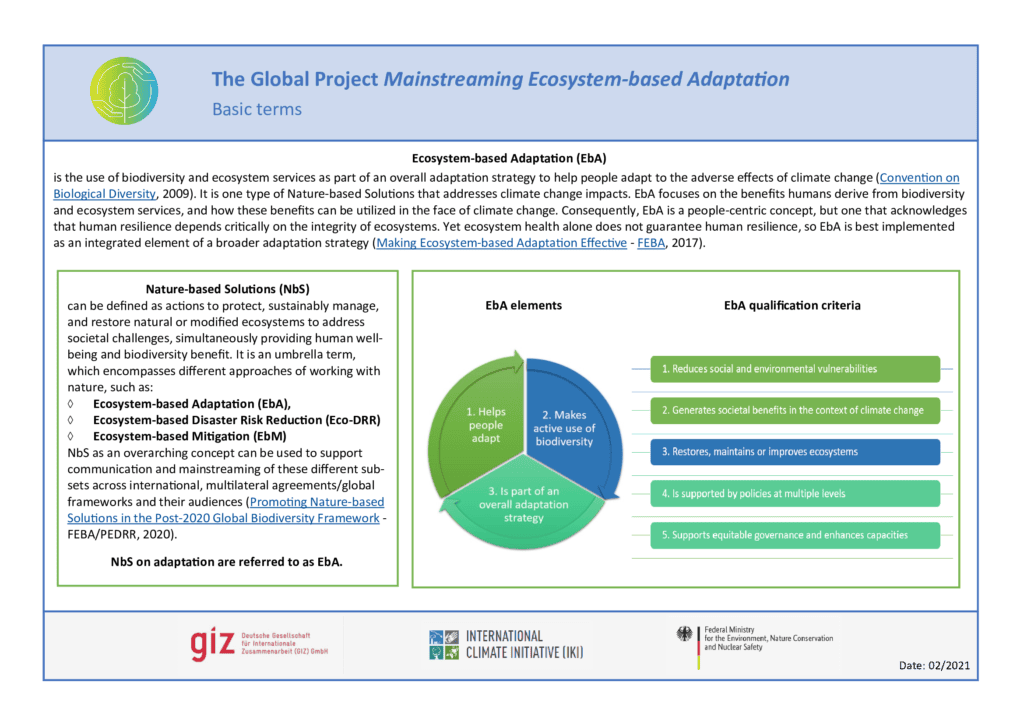
Understaning and explaining what Ecosystem-based Adaptation is can be tricky. This new facthseet developed by the Global project Mainstreaming EbA provides you with a brief overview and a simple visualization to help make the term EbA more clear. It also relates EbA to the now often discussed term ‘Nature-based Solutions’ and thereby offers an easy to remember bridge to avoid confusion.
Factsheet: The Global Project Mainstreaming Ecosystem-based Adaptation
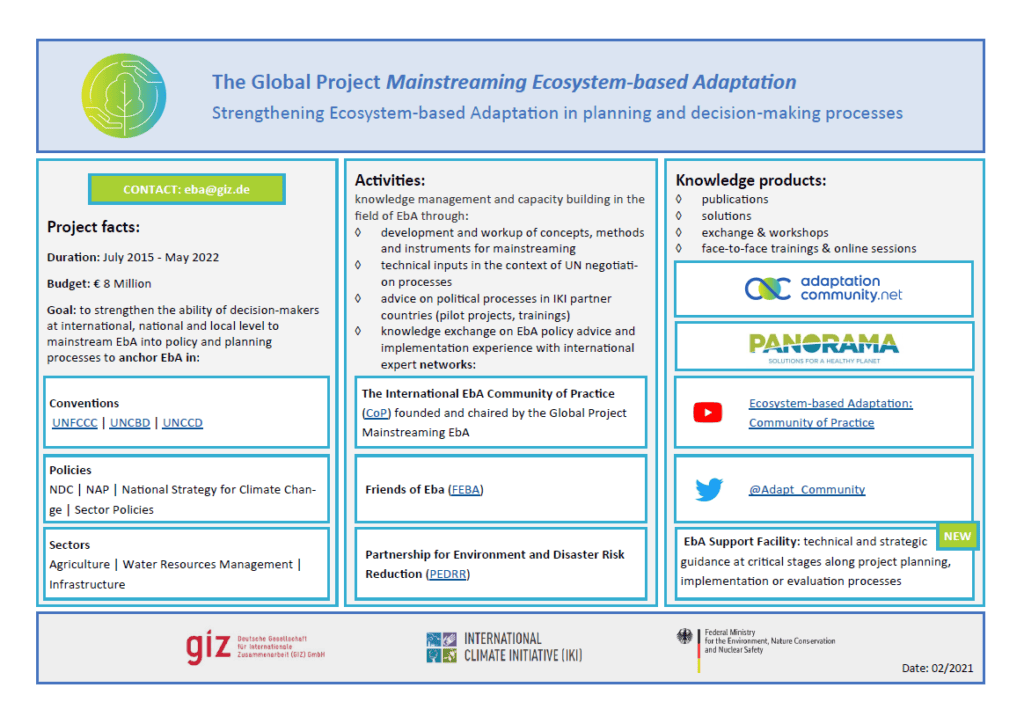
The Global Project Mainstreaming EbA is a knowledge management project supports actors at international, national and local level to incorporate ecosystem-based adaptation into policy and planning processes of different sectors. A focus of the project lies on knowledge management within an international EbA community of practice. With the help of additional networks, the global EbA project has developed a variety of concepts, strategies, methods and tools to promote EbA and to inform adaptation negotiations, policies, strategies and action plans.
Fiche technique Changement climatique et développement rural
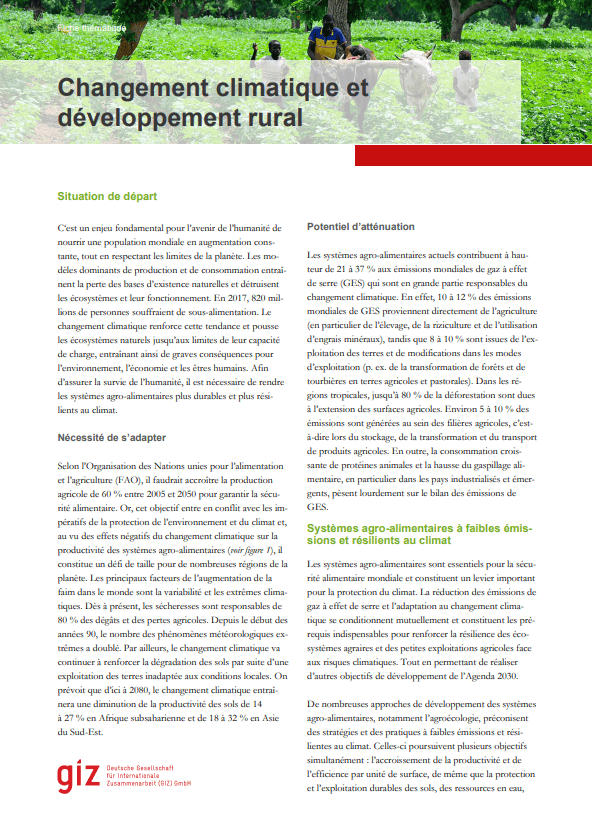
C‘est un enjeu fondamental pour l’avenir de l’humanité de nourrir une population mondiale en augmentation constante, tout en respectant les limites de la planète. Les modèles dominants de production et de consommation entraînent la perte des bases d’existence naturelles et détruisent les écosystèmes et leur fonctionnement. En 2017, 820 millions de personnes souffraient de sous-alimentation. Le changement climatique renforce cette tendance et pousse les écosystèmes naturels jusqu’aux limites de leur capacité de charge, entraînant ainsi de graves conséquences pour l’environnement, l’économie et les êtres humains. Afin d’assurer la survie de l’humanité, il est nécessaire de rendre les systèmes agro-alimentaires plus durables et plus résilients au climat.
Policy Advice for Climate-Resilient Economic Development (CRED) – Methods of assessing and planning climate-resilient economic development
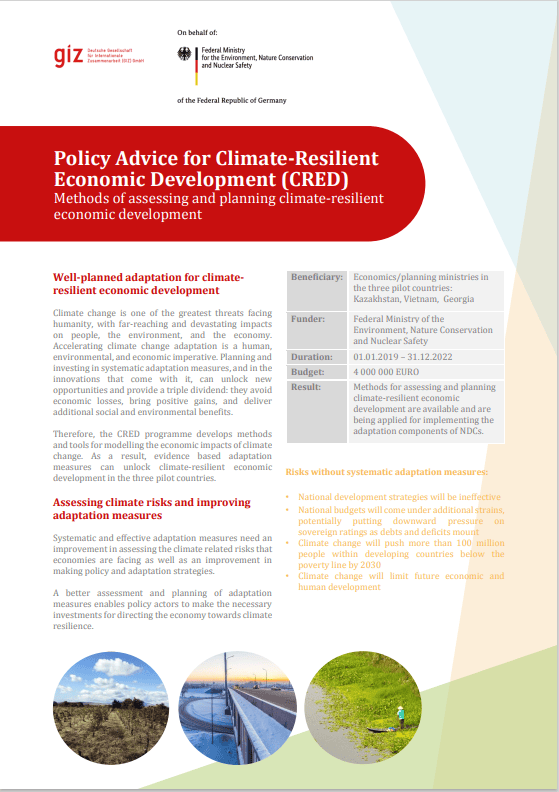
The CRED Factsheet introduces in the IKI program Policy Advice for Climate-Resilient Economic Development. The factsheet explains the need to assess climate risks and improve adaptation measures. It illustrates the CRED approach in developing human and technical capacities in macro-economic modelling of climate risks in the economic and planning ministries in Kazakhstan, Vietnam and Georgia. This aims at central macro-economic strategies and policies, supporting the implementation of NDC goals and national adaptation plans (NAP).
Planning for the future – Using scenario planning to improve the understanding and management of climate-induced migration
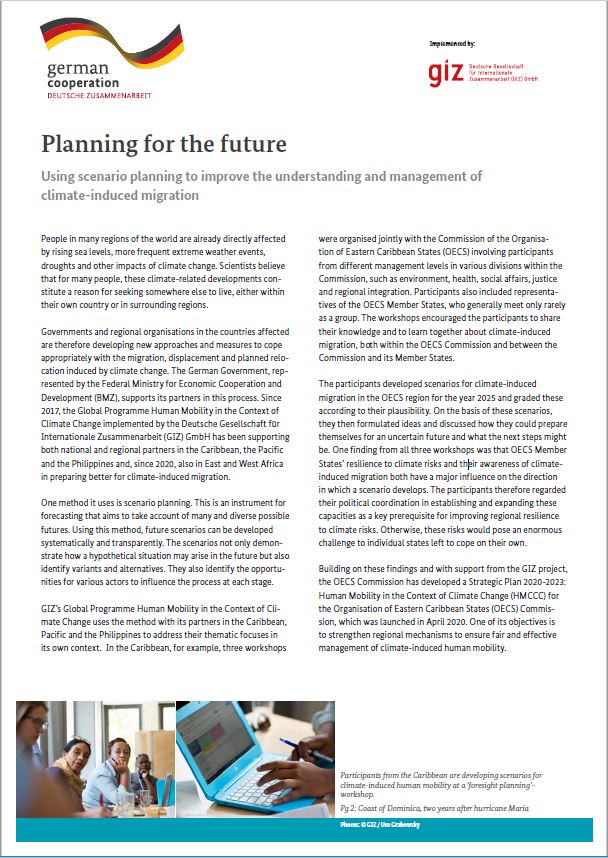
This factsheet provides an overview of scenario planning as an approach to deal with migration, displacement and planned relocation in the context of climate change. Scenario planning is a method that involves a wide range of stakeholders and serves as a tool for developing a range of future scenarios based on multiple factors and influences.
The Global Programme Human Mobility in the Context of Climate Change implemented by the Deutsche Gesellschaft für Internationale Zusammenarbeit (GIZ) GmbH has successfully applied scenario planning methods with its partners in the Caribbean, Pacific and the Philippines. In this context, valuable insights and important options for action could be identified.
Overview Document: Publications of the Global Project Mainstreaming EbA
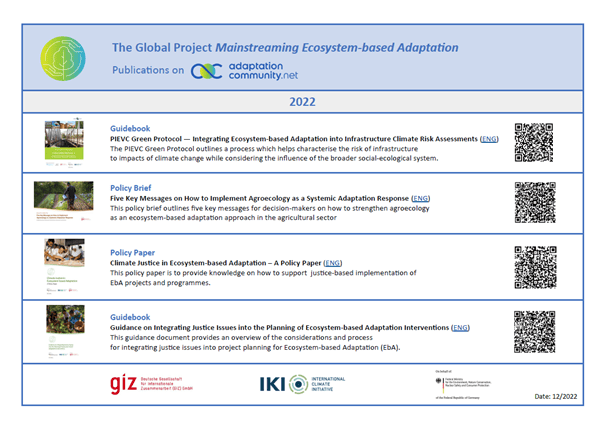
A compilation of all central knowledge products on Ecosystem-based Adaptation produced by the BMUV-IKI funded Global Project Mainstreaming EbA. The document contains both brief descriptions and links as well as QR-codes for each publication published between 2017 and the beginning of 2023 (Updated February 2023).
Vers l’opérationnalisation d’un système national de suivi-évaluation des actions climatiques au Burkina Faso
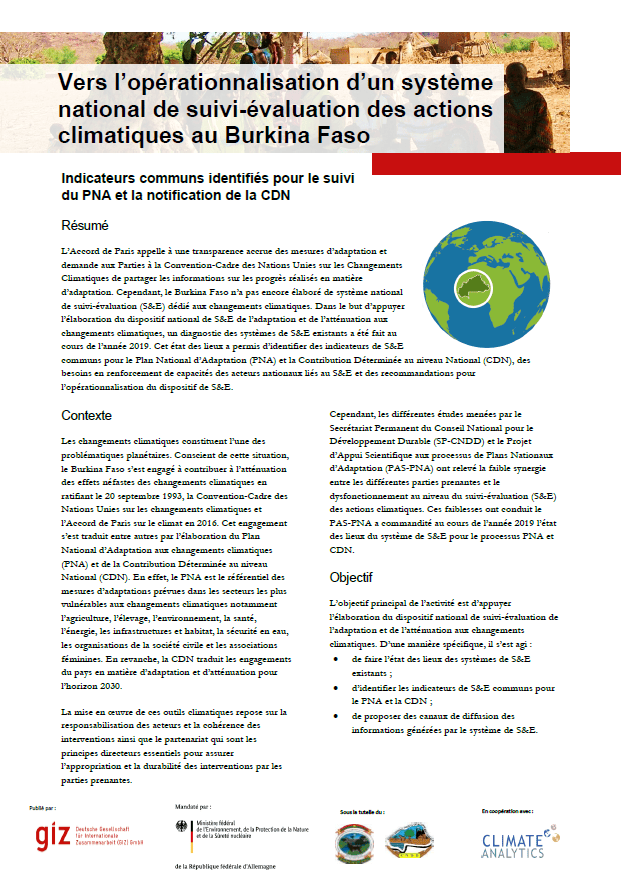
Dans le but d’appuyer l’élaboration du dispositif national de S&E de l’adaptation et de l’atténuation aux changements climatiques, un diagnostic des systèmes de S&E existants a été fait au cours de l’année 2019. Cet état des lieux a permis d’identifier des indicateurs de S&E communs pour le Plan National d’Adaptation (PNA) et la Contribution Déterminée au niveau National (CDN), des besoins en renforcement de capacités des acteurs nationaux liés au S&E et des recommandations pour l’opérationnalisation du dispositif de S&E.
Analyse des capacités nationales de planification de l’adaptation au Burkina Faso
Le Burkina Faso a analysé l’évolution des capacités nationales en matière de planification de l’ACC. Les évaluations ont été faites sur deux années consécutives en se basant sur les sept facteurs de succès de l’outil SNAP -Stocktaking for National Adaptation Planning- ou « Etat des lieux pour la planification de l’adaptation au niveau national ».
GIZ Factsheet: Human Mobility in the Context of Climate Change – Migration, Displacement and Planned Relocation in the Eastern Caribbean, the Pacific and the Philippines
This factsheet provides an introduction to the topic of HMCCC and gives an overview of relevant international policy frameworks. It looks at the partner regions and activities of the Global Programme on Human Mobility in the Context of Climate Change (GP HMCCC), implemented by GIZ on behalf of the German Federal Ministry for Economic Cooperation and Development (BMZ).
Elaboration des Notes Conceptuelles des idées de projet d’adaptation au Bénin
Le processus d’élaboration des Notes Conceptuelles des idées de projet d’adaptation a été initié dans le cadre de la mise en oeuvre de la composante 3 (Facilitation de l’accès au financement) du Projet d’Appui Scientifique aux processus de Plans Nationaux d’Adaptation (PAS-PNA). Les idées de projet ont été identifiées au Bénin suite à un concours d’idées organisé dans le cadre du partenariat avec le Fonds National pour l’Environnement et le Climat (FNEC). A l’issue dudit concours, deux idées de projet ont été retenues, à savoir un projet dans le secteur de l’agriculture et un second dans le secteur de la santé.