Gestión de riesgos climáticos – Trayectorias prometedoras para evitar, reducir al mínimo y afrontar las pérdidas y los daños
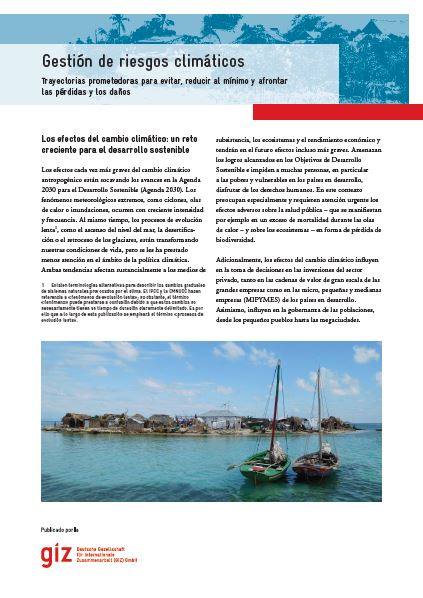
El marco de GRC del GP L&D es un enfoque iterativo basado en riesgos, dirigido a gestionar los riesgos climáticos considerando aspectos sociales, económicos, no económicos, institucionales, biofísicos y medioambientales. Este enfoque entiende las medidas de mitigación, adaptación al cambio climático y reducción del riesgo de desastres, así como la financiación y los seguros de riesgos, como partes complementarias de la misma caja de herramientas. A fin de obtener la combinación de medidas más inteligente posible para una situación dada, se enlazan de manera exhaustiva e integrada medidas avaladas en la práctica con instrumentos innovadores y enfoques transformadores.
Gestion des risques climatiques – Des voies prometteuses pour éviter les pertes et préjudices, les réduire au minimum et y remédier
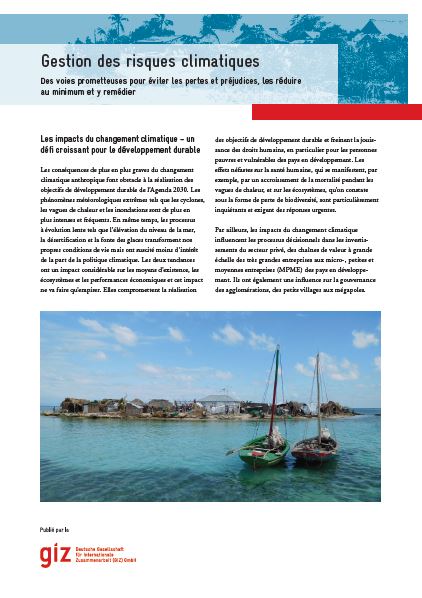
Le cadre de GRC du PM P&P (voir Figure 1) est une approche itérative, fondée sur le risque, de gestion des risques liés au climat, qui tient compte des aspects sociaux, économiques, non économiques, institutionnels, biophysiques et environnementaux. Il considère les mesures liées à l’atténuation, à l’adaptation au changement climatique, à la réduction des risques de catastrophes, au financement des risques et à l’assurance risques comme des éléments complémentaires d’une même boîte à outils. Afin de disposer de l’ensemble le plus efficace de mesures pour une situation donnée, il associe des mesures éprouvées à des instruments innovants et des approches transformationnelles, de manière globale et intégrée.
Climate Risk Management – Promising pathways to avert, minimise and address losses and damages
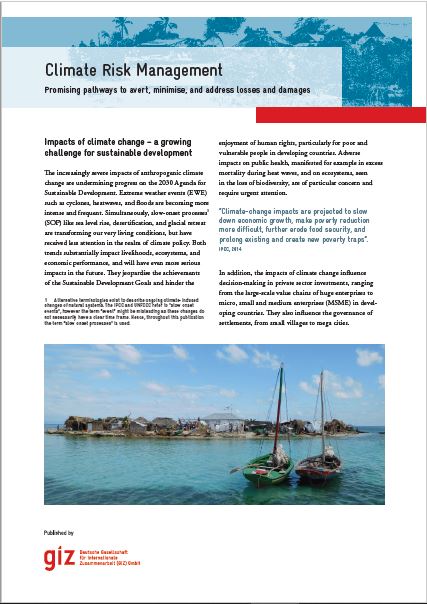
This factsheet summarises the findings of our study of the same name and gives a brief overview on the GP L&D’s CRM framework. Our CRM framework is a risk-based, iterative approach to managing climate-related risks, taking into consideration social, economic, non-economic, institutional, biophysical and environmental aspects. It understands measures related to mitigation, climate change adaptation, disaster risk reduction, and risk finance and insurance as complementary parts of the same toolbox. In order to attain the smartest mix of measures for a given situation, it links tried-and-tested measures with innovative instruments and transformational approaches in a comprehensive and integrated way.
Ficha informativa: Publicaciones del Proyecto Global “Integración de la AbE”

Una recopilación de todas las publicaciones sobre la adaptación basada en los ecosistemas producidos por el proyecto global “Itegración de la AbE” (Mainstreaming EbA) financiado por BMU-IKI. En el documento encontrarás breves descripciones y enlaces, así como códigos QR para cada publicación. De esta manera, obtener una visión general de lo que está disponible y encontrar lo que necesita es más fácil y rápido. La lista se actualizará periódicamente con nuevas publicaciones.
Ficha informativa: explicación de los términos AbE y SbN

Entender y explicar qué es la adaptación basada en los ecosistemas puede ser un desafío. Esta ficha informativa elaborada por el proyecto global “Integración de la AbE” (Mainstreaming EbA) ofrece una breve descripción y una sencilla visualización para ayudar a aclarar el término AbE, así como su relación con las “soluciones basadas en la naturaleza” (SbN), término utilizado con frecuencia en la actualidad.
Human Mobility in the Context of Climate Change – Implications of the COVID-19 Pandemic in the Eastern Caribbean
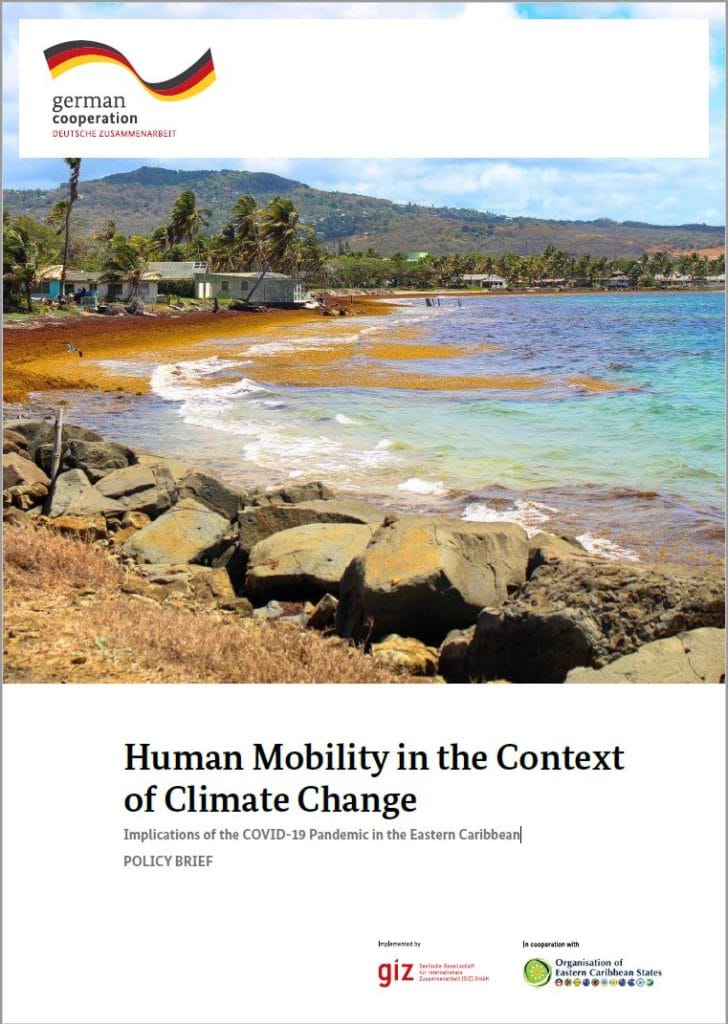
The Eastern Caribbean region is currently faced with a dilemma: On the one hand, the region is struggling with the management of the COVID-19 pandemic which has necessitated extended State of Emergency periods with established curfews and other measures to encourage people to stay home, practice social distancing and move as little as possible. Also, borders are largely closed, hence, the Free Movement of People Regime in the Organisation of Eastern Caribbean States (OECS) region is restricted due to COVID-19. These situations imply that people cannot move within the region and internal movements are also restricted. On the other hand, the OECS region is expecting an above-average active hurricane season which, based on past experience, might require people to move within their countries or across borders as a result of hurricanes or other climate-related events. These two different crises demand contrasting kinds of action: remaining versus moving.
Factsheet: Explanation of terms EbA and NbS
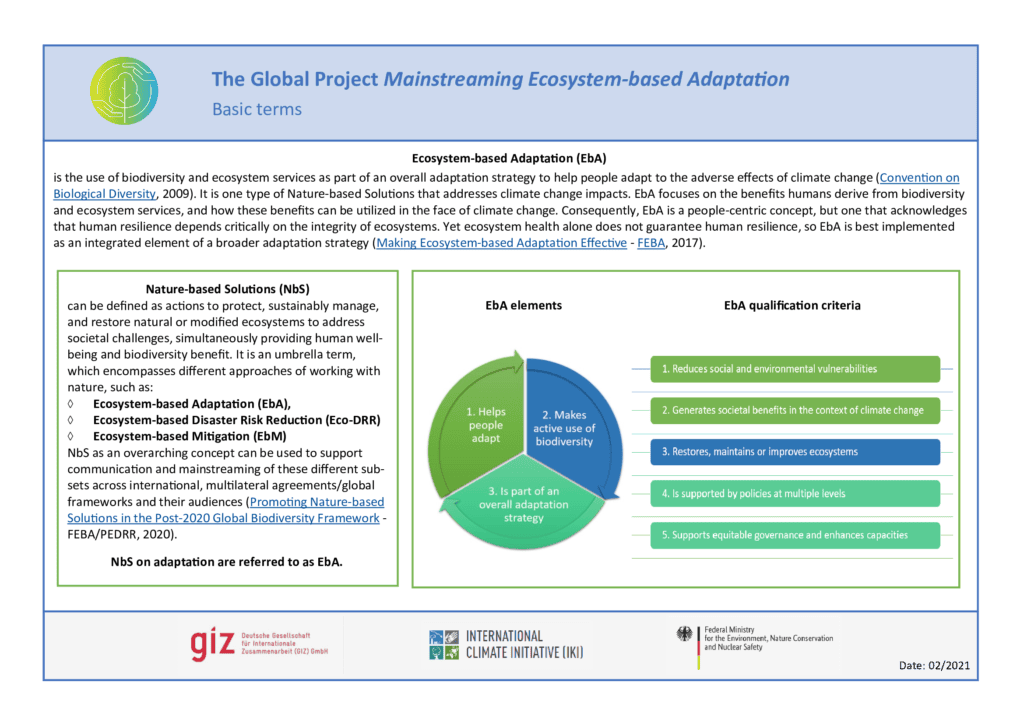
Understaning and explaining what Ecosystem-based Adaptation is can be tricky. This new facthseet developed by the Global project Mainstreaming EbA provides you with a brief overview and a simple visualization to help make the term EbA more clear. It also relates EbA to the now often discussed term ‘Nature-based Solutions’ and thereby offers an easy to remember bridge to avoid confusion.
Factsheet: The Global Project Mainstreaming Ecosystem-based Adaptation
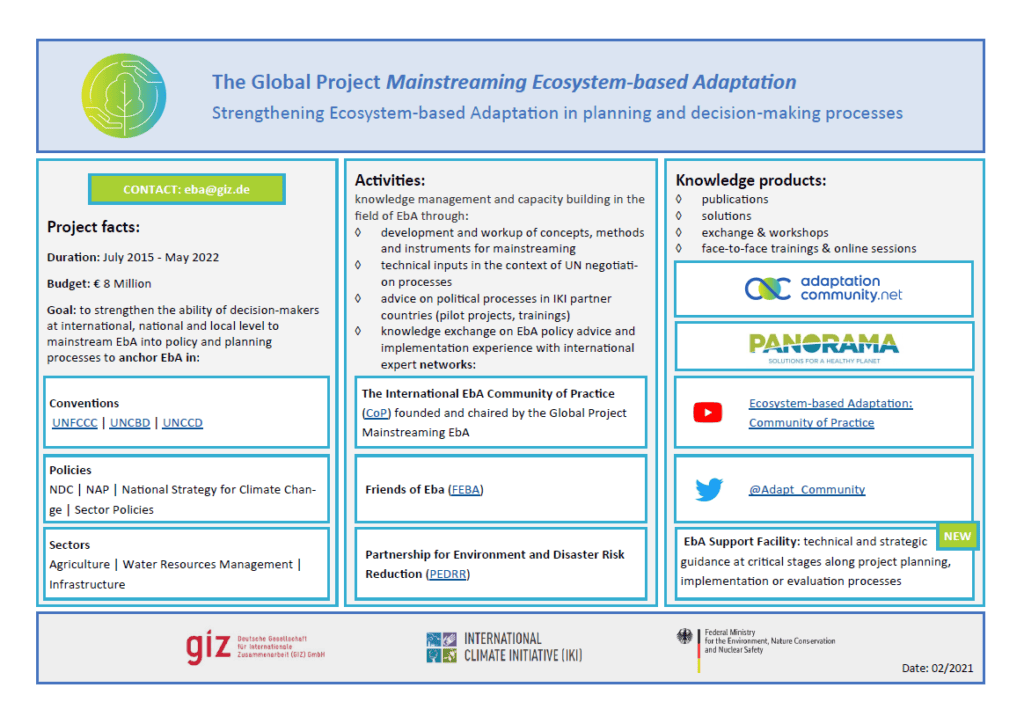
The Global Project Mainstreaming EbA is a knowledge management project supports actors at international, national and local level to incorporate ecosystem-based adaptation into policy and planning processes of different sectors. A focus of the project lies on knowledge management within an international EbA community of practice. With the help of additional networks, the global EbA project has developed a variety of concepts, strategies, methods and tools to promote EbA and to inform adaptation negotiations, policies, strategies and action plans.
Fiche technique Changement climatique et développement rural
C‘est un enjeu fondamental pour l’avenir de l’humanité de nourrir une population mondiale en augmentation constante, tout en respectant les limites de la planète. Les modèles dominants de production et de consommation entraînent la perte des bases d’existence naturelles et détruisent les écosystèmes et leur fonctionnement. En 2017, 820 millions de personnes souffraient de sous-alimentation. Le changement climatique renforce cette tendance et pousse les écosystèmes naturels jusqu’aux limites de leur capacité de charge, entraînant ainsi de graves conséquences pour l’environnement, l’économie et les êtres humains. Afin d’assurer la survie de l’humanité, il est nécessaire de rendre les systèmes agro-alimentaires plus durables et plus résilients au climat.
Policy Advice for Climate-Resilient Economic Development (CRED) – Methods of assessing and planning climate-resilient economic development
The CRED Factsheet introduces in the IKI program Policy Advice for Climate-Resilient Economic Development. The factsheet explains the need to assess climate risks and improve adaptation measures. It illustrates the CRED approach in developing human and technical capacities in macro-economic modelling of climate risks in the economic and planning ministries in Kazakhstan, Vietnam and Georgia. This aims at central macro-economic strategies and policies, supporting the implementation of NDC goals and national adaptation plans (NAP).