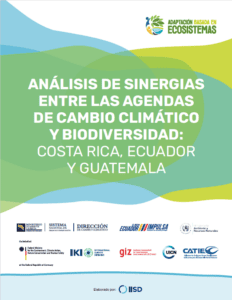
The program “Scaling Up Ecosystem-Based Adaptation Measures in Rural Latin America” (EbA-LAC), implemented in Costa Rica, Ecuador, and Guatemala, generated a valuable set of experiences that illustrate how the scaling up of EbA measures occurs in practice.
Based on 18 documented cases, it is evident that scaling up does not follow a single path but rather manifests itself through multiple trajectories that combine vertical processes—associated with public policies, management tools, and institutional frameworks—as well as horizontal processes linked to the community-level, subnational/territorial, and sectoral replication of successful practices.
The purpose of this publication is to share lessons learned about the success factors that enabled the scaling up of EbA in the three countries, using a strategic framework that integrates the dimensions of i) governance, ii) capacity building, and iii) enabling conditions, throughout the EbA mainstreaming cycle.