Business opportunities in climate change adaptation: Business models, implementation tools, and access to finance
Context
The science is clear: Climate action across the world is more urgent than ever. But even the best efforts to minimize human activities that accelerate global warming are now too little too late to avert the already apparent and expected impacts of a changing climate. The urgent need to adapt to the impacts of climate change is therefore also clear. This comes with opportunities for innovation and with business opportunities to meet a growing demand for products and services that build resilience and enable adaptation to the impacts of climate change. As literacy on climate risks improves, and markets for adaptation solutions develop, investor interest is also increasing.
About the Private Adaptation Investment Bootcamp (PrivABoo)
The program aims to support growth-stage to small and medium-sized enterprises (SMEs) that offer climate adaptation-relevant technologies, products or services (“Adaptation SMEs”) to their clients and to connect them with impact investors, who want to build a portfolio in climate change adaptation. PrivABoo is designed as a flexible and dynamic learning cycle that responds to the participants’ individual needs , aiming to increase their capacity to recognize, finance and scale business opportunities in the field of climate change adaptation.
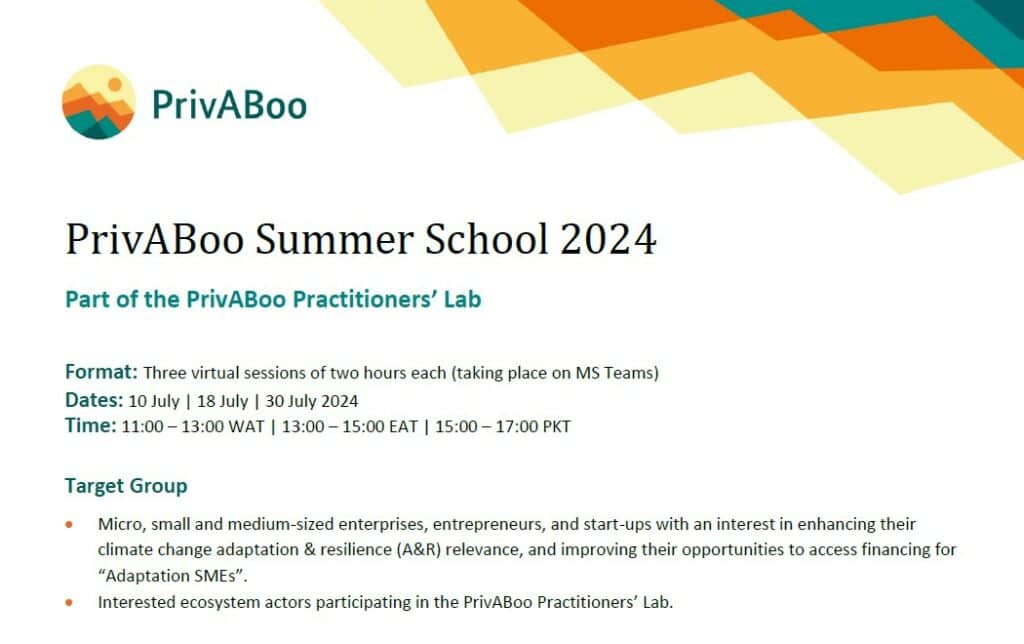
PrivABoo Practitioners Lab | Summer School 2024
The Summer School aims to delve into the climate context surrounding surrounding Small and Medium-sized Enterprises (SMEs) engaged in adaptation efforts, along with the corresponding business and investment opportunities. In addition, it will comprise discussions on adaptation tools and methodologies, along with opportunities for financing SMEs’ climate change adaptation initiatives.
The Summer School is organized as part of the PrivABoo Practitioners’ Lab which offers participants a space to connect, exchange and pool expertise to drive investment in business models for climate change adaptation. The aim is to support the transfer of knowledge to mobilize climate change adaptation investments in and from the private sector.
Sessions
1) Introduction, context and SME business models for climate change adaptation
(10 July 2024, 13.00h – 15.00h EAT)
Learning objective: To get familiar with the climate change context within which a business operates; be able to define “Adaptation SMEs” and understand demand, opportunities, experiences, and challenges for SMEs with adaptation business models.
• Climate science and climate change impacts: What we know about climate change, what is already being experienced, what can be expected, and what that means for SMEs in different regions and sectors.
• International climate agreements and negotiations, national commitments and action plans, and the role of small businesses.
• Vulnerability, resilience, and business opportunities in adaptation – anticipating and meeting demand for products and services that reduce vulnerability, build resilience, and advance adaptation.
• Defining adaptation SMEs and adaptation business models: The business case for measuring, increasing, and communicating adaptation impact.
2) Demonstrating Impact: Approaches, tools, and examples
(18 July 2024, 13.00h – 15.00h EAT)
Learning objective: To become acquainted with different approaches and tools for measuring, managing, and communicating adaptation impact
• Maximising adaptation impact: An introduction for Adaptation SMEs and their partners
• Tools, approaches and support: A practical guide for Adaptation SMEs
• Adaptation business in action: PrivABoo peer panel and facilitated Q&A
3) Financing and Support for Adaptation SMEs
(30 July 2024, 13.00h – 15.00h EAT)
Learning objective: To identify financing and investment opportunities for Adaptation SMEs; engage with investors with an interest in / programs aimed at / portfolios that include Adaptation SMEs.
• Opportunities and challenges for adaptation SMEs in the climate finance landscape
• Investor interests and investment criteria in adaptation – featuring investor guest speakers
• Support systems for incubation, acceleration, and investment readiness
How to register
Please send an e-mail to josue.arguedas@giz.de and lisa.scholz@giz.de with the participants’ name, position and e-mail address, as well as name and website of your organization.
• Up to 2 participants for organization can attend the sessions.
• Participants who attend all three sessions and actively participate in the group works and exercises will receive a participation certificate from GIZ.