
Five Key Messages on How to Implement Agroecology as a Systemic Adaptation Response
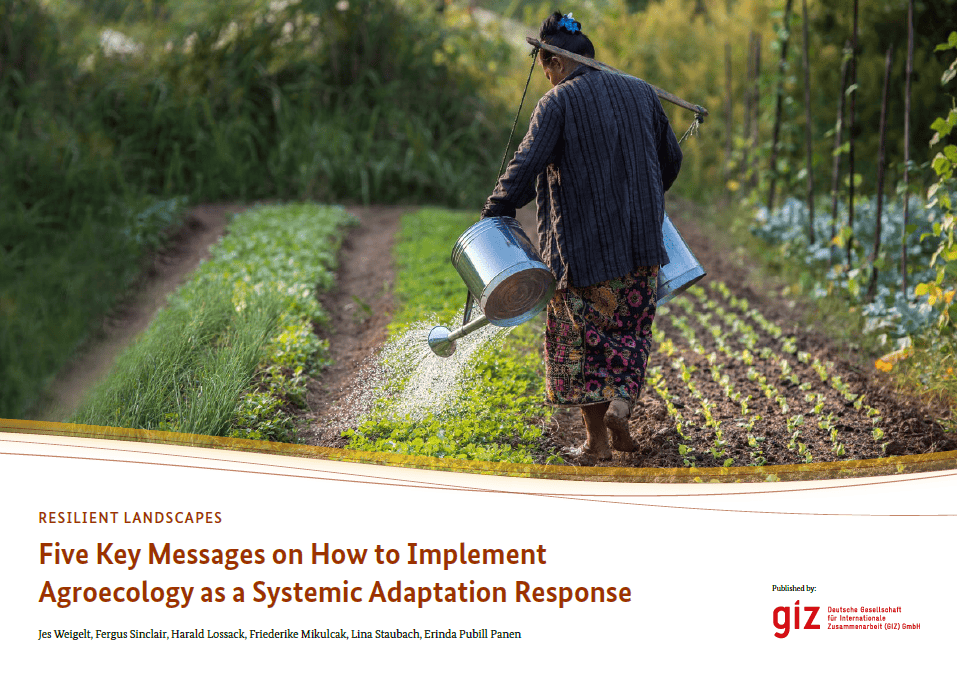
This policy brief introduces the benefits of aligning the approaches of agroecology and Ecosystem-based Adaptation for a (climate) resilient and nature-friendly transformation of agri-food systems. It presents five key messages, including the need for a systemic transformation, alliances for change, circular knowledge transfer, the creation of an enabling environment and local-responsive financial support.
PIEVC Green Protocol — Integrating Ecosystem-based Adaptation into Infrastructure Climate Risk Assessments
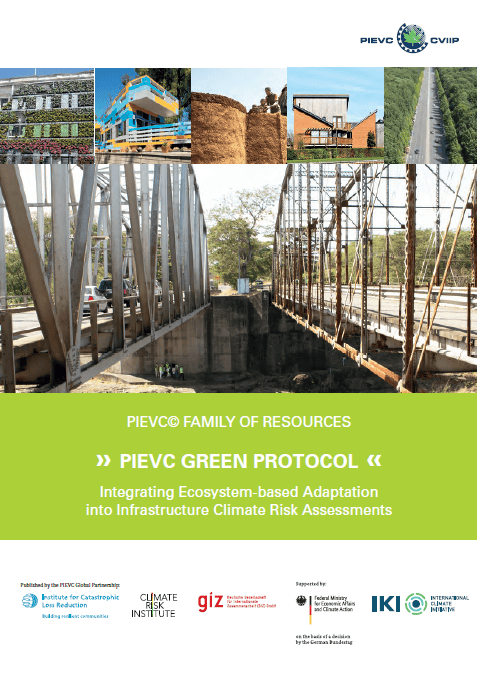
The PIEVC Green Protocol describes a step-by-step methodology of risk assessment and optional engineering analysis for evaluating the risk of climate change on infrastructure, while considering the broader social and environmental systems within which the infrastructure component is situated. Information developed through the assessment process will assist owners, operators and other professionals, to effectively incorporate climate change adaptation into design, development and management of existing and planned infrastructure and its surrounding environment, including ecosystems.
Climate Justice in Ecosystem-based Adaptation – A Policy Paper
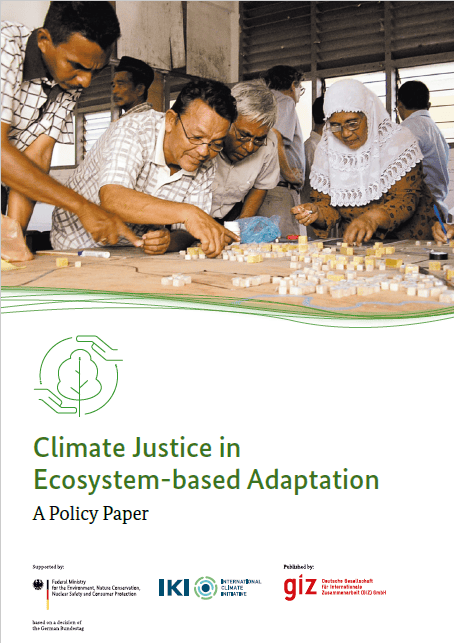
This publication gives an overview of justice challenges in EbA and outlines the international context. It highlights entry points for enhancing justice based EbA in project planning and implementation, the international climate and biodiversity finance system as well as in the national context.
Guidance on Integrating Justice Issues into the Planning of Ecosystem-based Adaptation Interventions
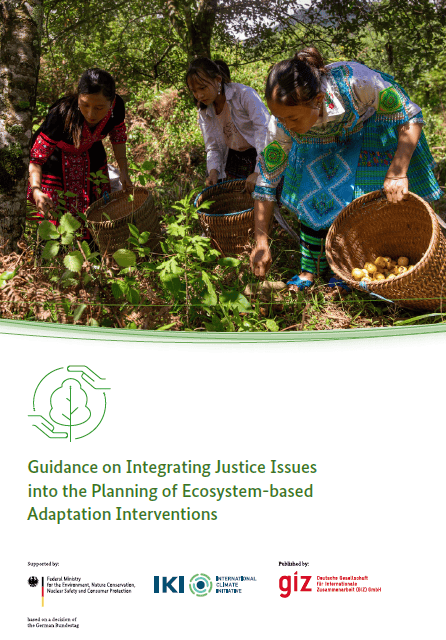
This tool provides practitioners and project planners with concrete entry points for anchoring justice in EbA project planning. It gives guidance on strategic frameworks, formulating project objectives and measures and anchoring justice in the institutional and financial setup. It also explains key steps how to best involve stakeholders in setting up the M & E system. An online introduction to the Climate Justice Planning Tool is also available.
Guidance on Integrating Justice Issues into the Monitoring and Evaluation of Ecosystem-based Adaptation Interventions
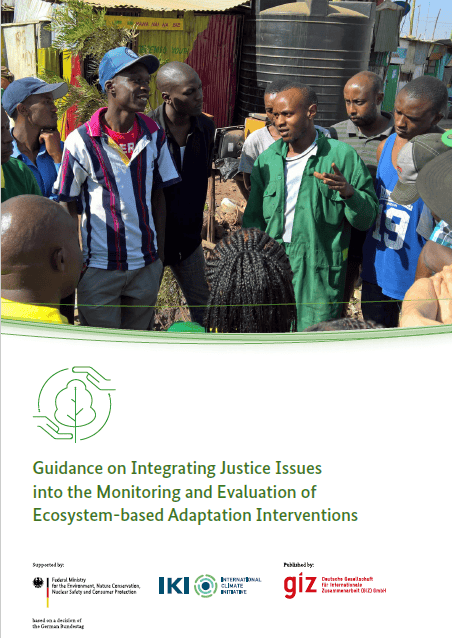
This guidance document provides an overview of the considerations and process for integrating justice issues into the monitoring and evaluation (M&E) of Ecosystem-based Adaptation (EbA) interventions. It is primarily aimed at the practitioners and planners who design and implement EbA on the ground, offering them guidance on how to integrate justice aspects into M&E and especially into indicators. An online introduction to the Climate Justice M&E Tool is also available.
Climate Justice in EbA: the new publications collection
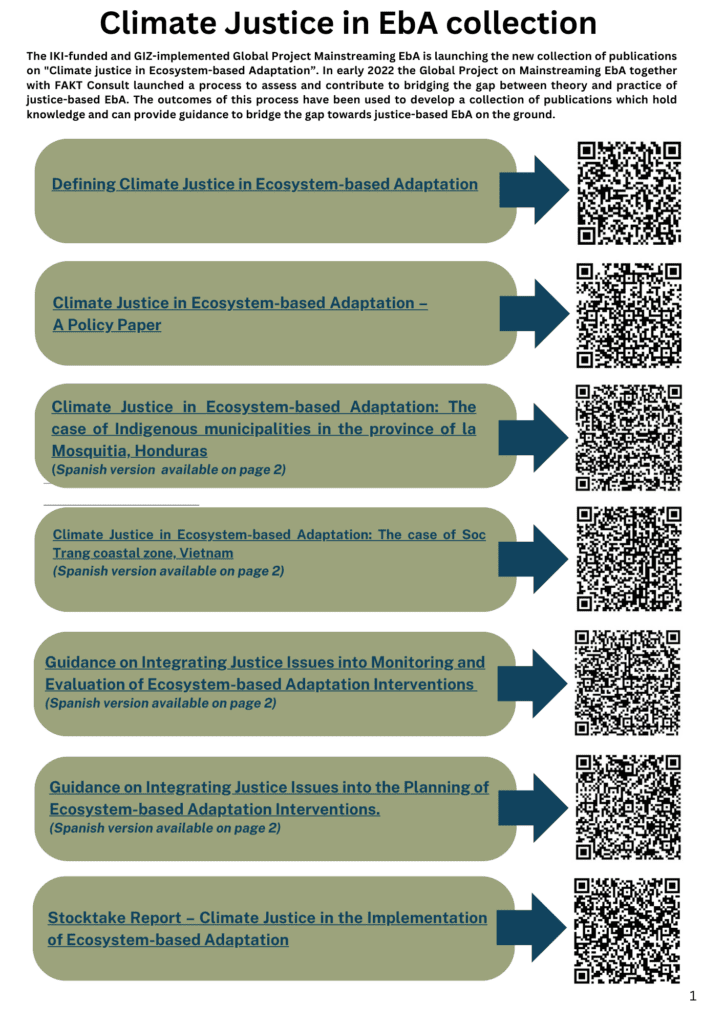
The IKI-funded and GIZ-implemented Global Project Mainstreaming EbA is launching the new collection of publications on “Climate justice in Ecosystem-based Adaptation”. In early 2022 the Global Project on Mainstreaming EbA together with FAKT Consult launched a process to assess and contribute to bridging the gap between theory and practice of justice-based EbA. The outcomes of this process have been used to develop a collection of publications which hold knowledge and can provide guidance to bridge the gap towards justice-based EbA on the ground.
Climate Justice in Ecosystem-based Adaptation: The case of Indigenous municipalities in the province of la Mosquitia, Honduras
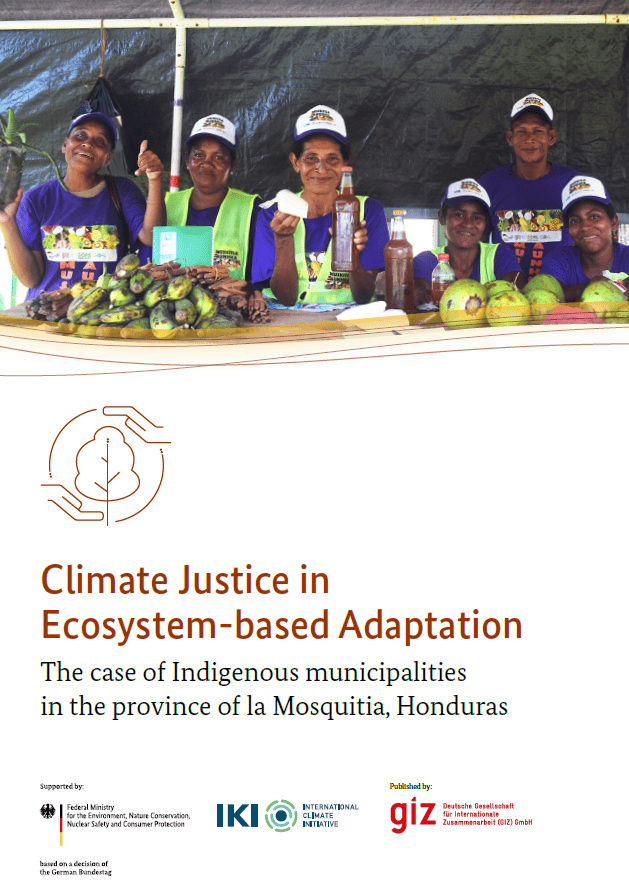
The case of Honduras / La Mosquitia illustrates the importance of integrating justice issues into the project during the early stages of planning. It is especially important to integrate these issues into governance structures and processes in the project area, although project management needs to consider them as well. Entry points for anchoring justice issues strategically include the project concept, steering structure, monitoring and evaluation (M&E) system and the staff concept. Integrating the various dimensions of justice – recognition justice, procedural justice and distributive justice – through these entry points is a key prerequisite for justice to be considered in project implementation.
Climate Justice in Ecosystem-based Adaptation: The case of Soc Trang coastal zone, Vietnam
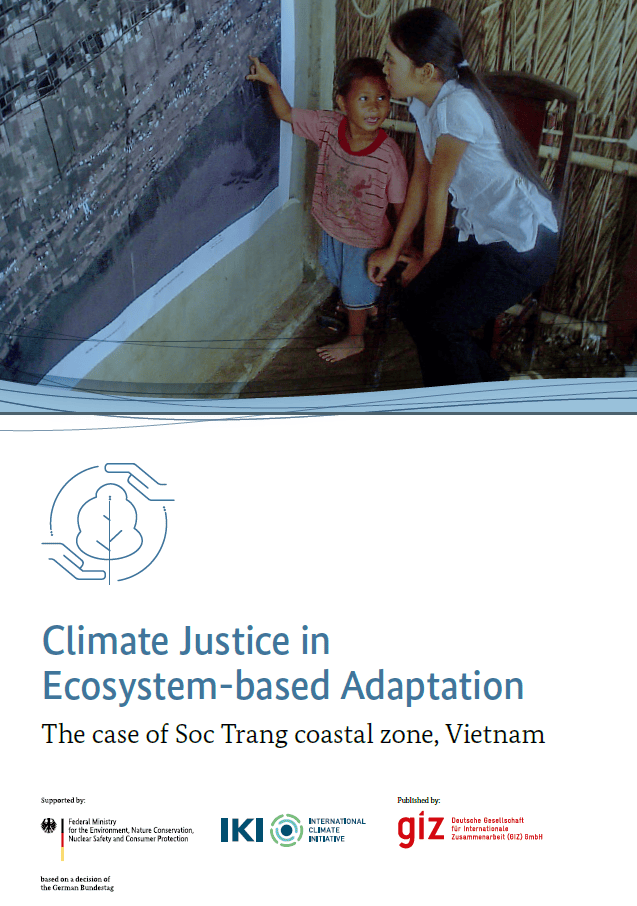
The case of Vietnam / Soc Trang illustrates the importance of climate justice as a precondition for successfully and sustainably protecting mangrove forests. Mangrove forests protect the coast and people from storms and flooding. Additionally, the ecosystem provides other co-benefits, like the increase of income through fisheries by providing nursery grounds, food, shelter and habitat for a wide range of aquatic species. The case highlights how a justice-based implementation approach strengthened equal participation and benefits of a co-management approach, which actively promoted different dimensions of climate justice.
Defining Climate Justice in Ecosystem-based Adaptation
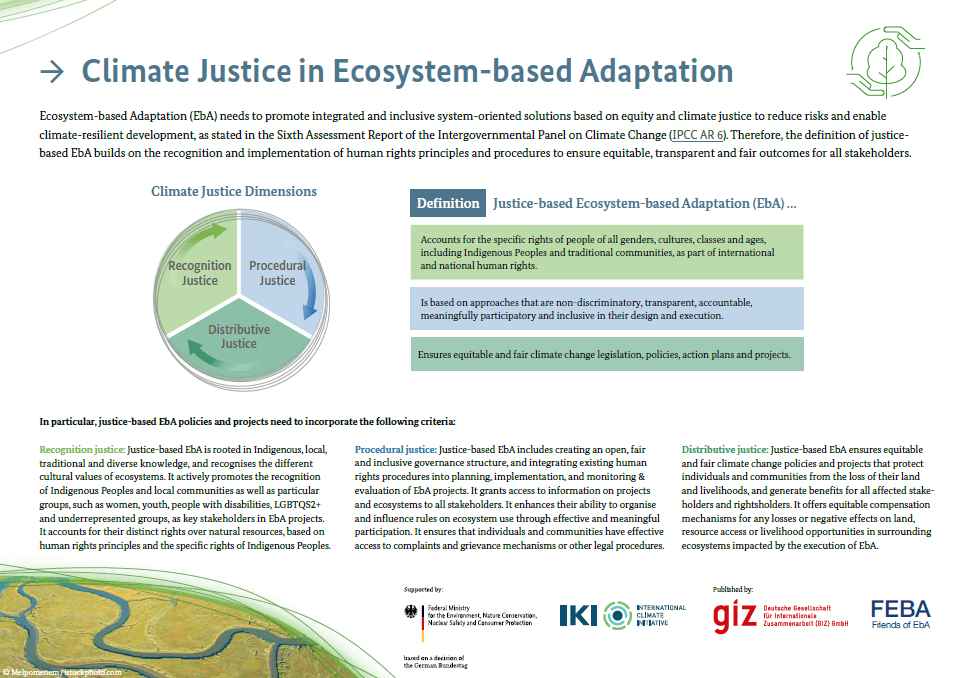
The definition of justice-based EbA builds on the recognition and implementation of human rights principles and procedures to ensure equitable, transparent and fair outcomes for all stakeholders. It includes three climate justice dimensions: Recognition Justice, Procedural Justice and Distributive Justice.
Technical Brief: Promoting Synergies Between Climate Change Adaptation and Biodiversity
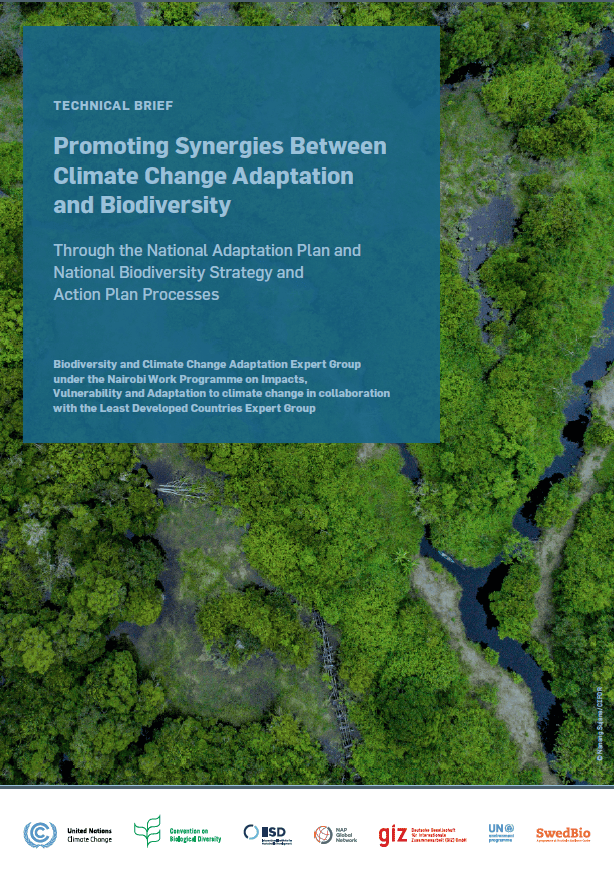
The technical summary presents a framework that highlights common elements in the adaptation and biodiversity planning process and provides insights into relevant case studies from different countries that illustrate key lessons learned and best practices. These could be applied or inspire the revision, formulation and implementation of the National Adaptation Plans (NAPs) and National Biodiversity Strategy and Action Plan Processes (NBSAPs), to promote synergies and efficient resource allocation.