What are you looking for?

Climate
Change

is one of the greatest challenges of our time

Climate
Change

is one of the greatest challenges of our time

People and states worldwide are already affected by its destructive impacts. Especially developing countries are vulnerable to global warming and its consequences. With the adoption of the Paris Agreement, its global goal on adaptation has been set as an indispensable component of climate action equal to mitigation.

featured

From Innovation to Learning

The CDRFI Evidence Roadmap compiles existing knowledge, identifies areas where evidence is still missing, and encourages better data collection across programmes and partners. Its goal: to enable smarter decision-making and scale approaches that deliver real impact. 

Drafted and reviewed by researchers, donors, implementers, governmental and civil society representatives from the CDRFI community, the roadmap also promotes learning across countries and institutions, sharing experiences and lessons to make CDRFI investments more effective, transparent, and responsive to growing climate risks. 

Read the publication and learn from the evidence how to shape smarter CDRFI strategies.

latest

How can social protection systems help societies prepare for climate disasters before they happen? An interactive web story developed by GIZ taskforce on Adaptive Social Protection...

Eleven farmers are working in the field
COP30 delivered two signals that frame the outlook for 2026: first, the political commitment to significantly scale up adaptation finance under the new collective quantified...
The outside of the UN conference building in Bonn with big glass windows, surrounded by trees.
Ten years after the adoption of the Paris Agreement, climate adaptation has become a defining element of global climate policy. This shift did not begin...
At COP21 the director, president, president of the COP and the executive secretary of UNFCCC are holding their hands up in celebration on a stage.

Topics

  • As the negative impacts of climate change are expected to intensify in the near future, Climate Risk Assessment and Management aims at averting, minimising and addressing loss and damage.
  • Climate Services (CS) provide decision-makers with customized ready-to-use climate information and products (forecasts or historical trends) to effectively manage climate risk. 
  • Economics of Climate Adaptation considers the need to assess the economic impact of climate risks and to develop adaptation options that contribute to economic development and human well-being in a systemic way. 
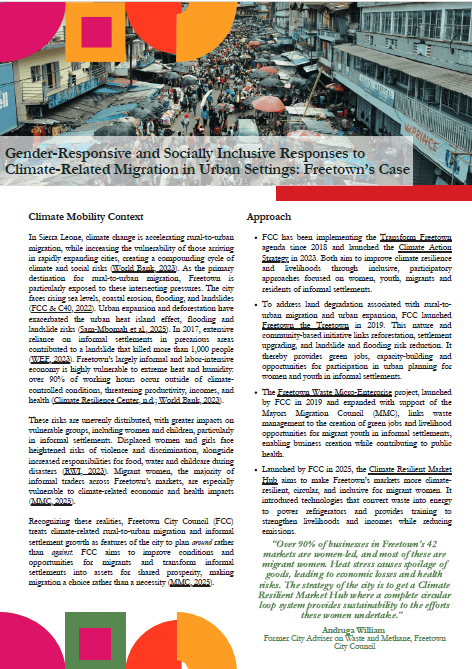
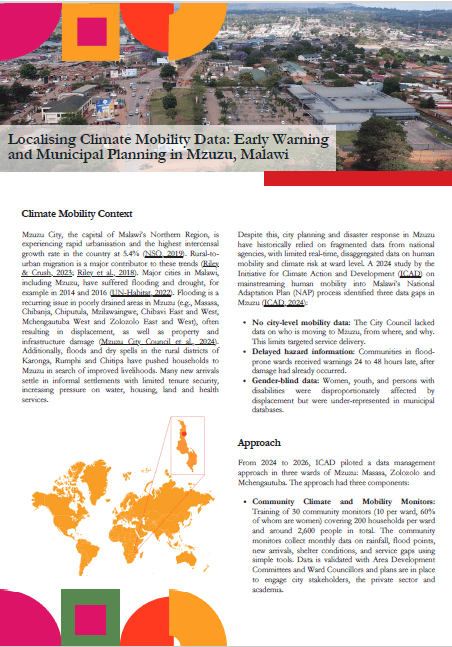
  • Human Mobility in the Context of Climate Change  looks at how extreme weather events and gradual changes impact human mobility: migration, (disaster) displacement, as well as planned relocation.
  • Mainstreaming of Adaptation systemically includes climate risk and adaptation considerations in decision-making and planning processes. 
  • The National Adaptation Plan (NAP) process aims to integrate adaptation into development planning and to reduce vulnerability to climate change. As the primary national planning process for adaptation, it can support the implementation of NDC adaptation goals. 
  • Agroecology aims at transforming agricultural and food systems towards climate resilience and adaptiveness in order to achieve food security for all. 
  • Ecosystem-Based Adaptation (EbA) is the sustainable use of biodiversity and ecosystems to help people adapt to the adverse effects of climate change. 
  • Urban Climate Resilience refers to the ability of an urban system – and its components – to absorb, adapt to, and recover from the various shocks and stresses exacerbated by climate change, while ensuring the well-being of its inhabitants. 

Monitoring and Evaluation (M&E) helps keeping track of the implementation of adaptation measures and assessing their effectiveness and outcomes. The Paris Agreement encourages “M&E and learning from adaptation plans, policies, programmes and actions” (Article 7.9d). 

Solutions

Guides & Manuals
To reverse the trend of declining biodiversity, locally adapted biodiversity-enhancing practices are needed. This is a guide for practitioners in agricultural and rural development to identify, adapt, and promote such practices....
Fact sheets
The Loss and Damage governance framework consists of three main bodies: The Warsaw International Mechanism (WIM), which functions as the ‘policy arm’; the Santiago Network under the WIM, which functions as the ‘technical arm’; and the Funding Arrangements including a Fund for responding to Loss and Damage (FRLD), which forms...
Report
This report presents insights how sea-level rise may affect land availability across economic sectors in Vietnam. It illustrates how potential land loss across regions and economic sectors can be projected by using spatial analysis combining sea-level rise projections, elevation data and land-use information....

Connect

Follow us on LinkedIn to stay informed on the latest developments in the climate adaptation community.