Portfolio Screening: Impacts and Risks of Climate Change to Brazilian Coastal Public Ports – Executive Summary
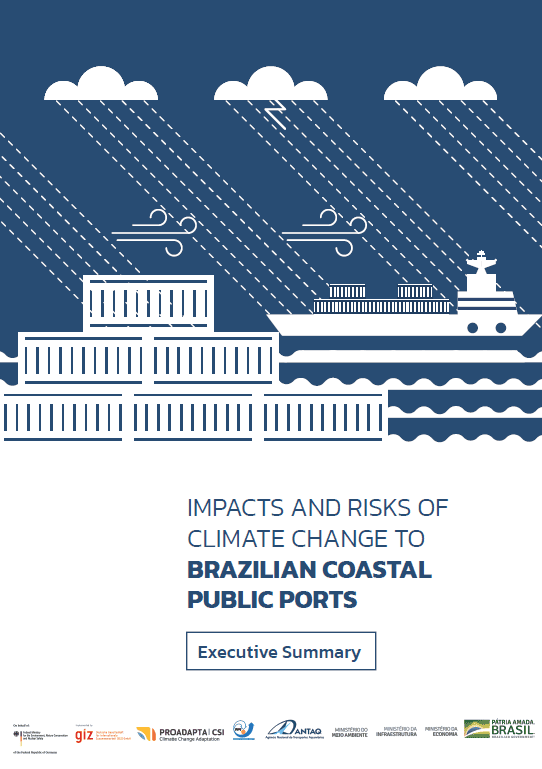
Coping with the consequences of climate change is one of the most complex challenges of Brazil.
The port sector is among the sectors that can directly face the impacts from climate change — specially
because port infrastructure is highly exposed to climatic hazards. The report includes a climate risk assessment for 21 public ports with actionable policy recommendations. This Portfolio Screening is based on the PIEVC Protocol.
PIEVC Green Protocol — Integrating Ecosystem-based Adaptation into Infrastructure Climate Risk Assessments
The PIEVC Green Protocol describes a step-by-step methodology of risk assessment and optional engineering analysis for evaluating the risk of climate change on infrastructure, while considering the broader social and environmental systems within which the infrastructure component is situated. Information developed through the assessment process will assist owners, operators and other professionals, to effectively incorporate climate change adaptation into design, development and management of existing and planned infrastructure and its surrounding environment, including ecosystems.
PIEVC High Level Screening Guide: A guide to completing screening level climate change risk assessments using the PIEVC Process
This PIEVC High Level Screening Guide (HLSG) is based on standard climate risk assessment methods and is part of the PIEVC Family of Ressources. The PIEVC HLSG process is an approach for undertaking vulnerability, risk, and resilience assessments. It is flexible enough to be applied to full assets or systems, to a single element of infrastructure, or to an entire portfolio of numerous assets. PIEVC HLSG assessments result in the characterization and ranking of climate risk scenarios and the identification of those scenarios of highest priority for adaptation planning or more comprehensive analysis.
PIEVC Large Portfolio Assessment Manual — A Guide for Prioritizing a Large Portfolio based on Climate Vulnerability
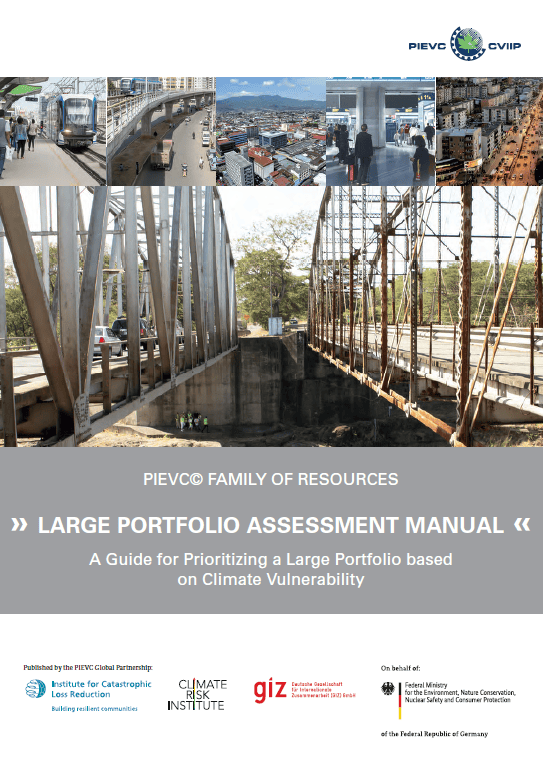
Part of the PIEVC Family of Resources, this manual provides guidance for infrastructure owners on how to use vulnerability and risk assessment to inform priority setting and managing climate resilience of a large portfolio of assets. It defines portfolio as a collection of infrastructre assets that are characterized by different climate vulnerabilities and risks.
PIEVC Catalogue — A Guide for Selecting Climate Risk Assessment Methods, Data, and Supporting Materials
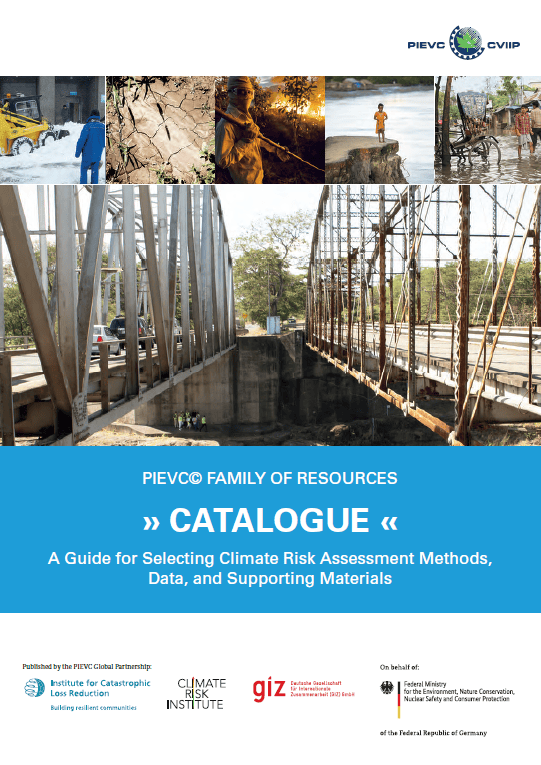
The PIEVC Catalogue is designed to help decision-makers navigate through the different considerations and options for assessing climate change risk and resiliency using the PIEVC Family of Resources. The catalogue guides the users through the objective-setting process and based on their objectives, helps them choose the optimum assessment paths and tools.
Cai Lon – Cai Be sluice gate climate risk assessment
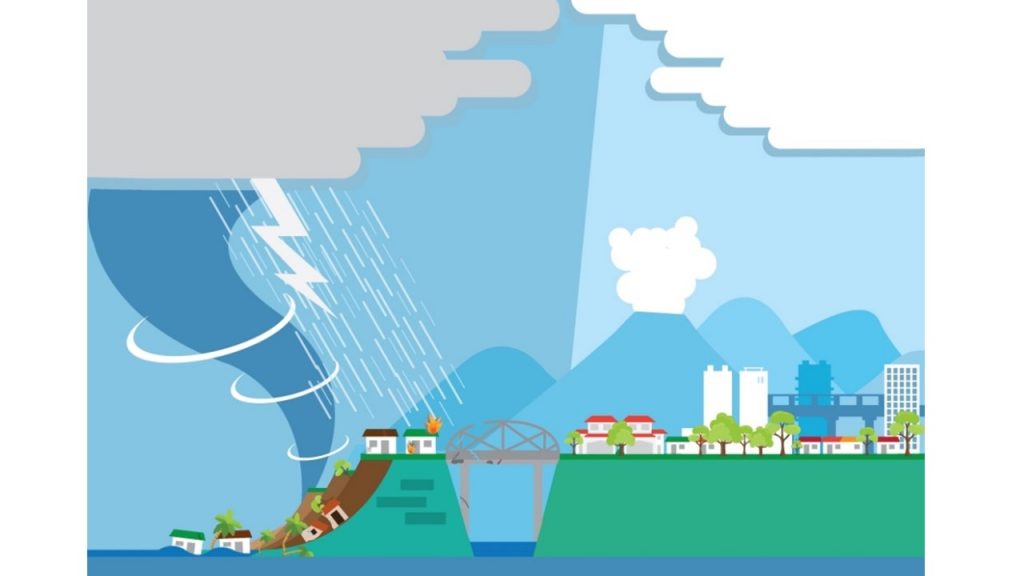
An infrastructure-oriented climate risk assessment was piloted for the planned Cai Lon – Cai Be sluice gate system project in the Mekong Delta– an infrastructure investment by the Government of Vietnam with an estimated budget of USD 145 million, starting from 2018 until 2021 with a significant function to prevent salt water intrusion, especially with regards to higher probabilities of severe droughts.
A recipe for the service of climate risk assessment
To facilitate and streamline the replica of the Cai Lon-Cai Be sluice gate climate risk assessment in Vietnam, this document provides a detail description of the kind of services needed. Based on the structure of a typical recipe, the provided services are divided in three components; procedure, quantity and costs.
Climate risk assessment on infrastructure: A report about the bridge over the Tempisque river in Guardia, Costa Rica
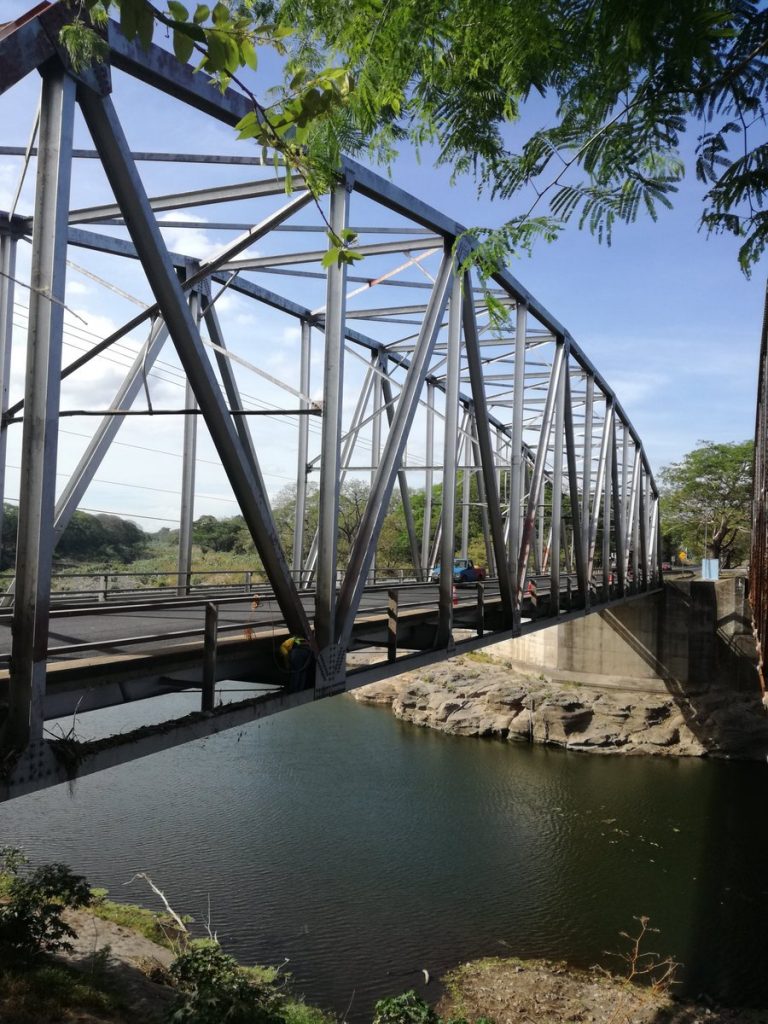
In a nutshell, the report provides decision-makers with necessary information to adopt adaptation measurements towards the maintenance and operation of a climate-resilient bridge. Of equal importance is the development of capacities among as well as the mainstream of the approach. Lastly, the assessment has incentivised to develop of a climate risk assessment tool tailor-made to the Costa Rican context.
Guide de bonnes pratiques pour la conduite d’études de vulnérabilité aux changements climatiques en Afrique de l’Ouest
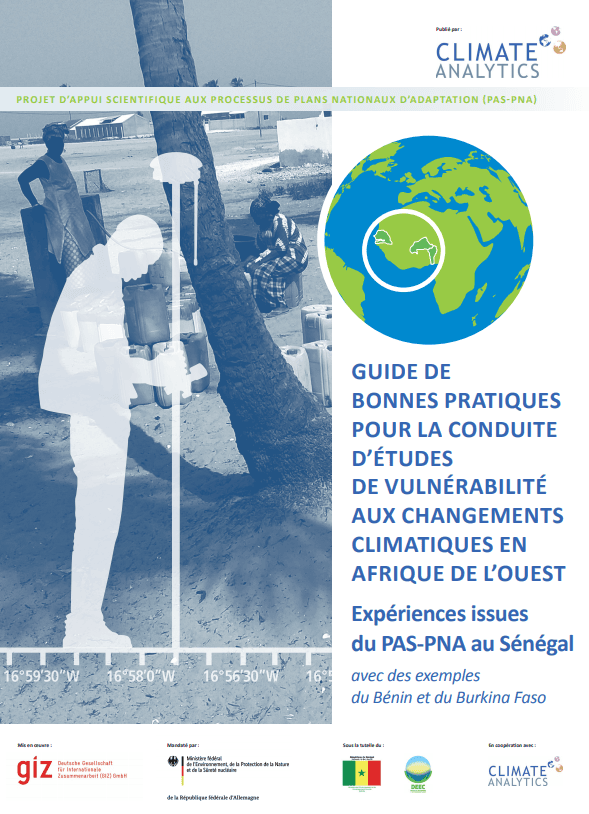
Ce guide pratique vise à présenter les approches utilisées par Climate Analytics dans le cadre du PAS-PNA (co-développement des méthodes et renforcement des capacités) ; à partager les leçons apprises et identifier les pratiques qui fonctionnent bien ; et à fournir un cadre de référence qui puisse permettre aux acteurs/parties-prenantes de reproduire les études de vulnérabilité à travers une approche de renforcement de capacité et en utilisant une méthodologie robuste.
Comprendre et interpréter les sorties de modèles climatiques pour la conduite des études de vulnérabilité
Guide à l’attention des praticiens et des chercheurs pour se familiariser avec une gamme variée de sorties de modèles climatiques et pour analyser les résultats des modèles suivant leur contexte.